
The Enduring Wisdom of Carmel: Amazing Grace
Carmel does not simply preserve wisdom from the past. It continually rediscovers that wisdom within the questions and circumstances of the present.
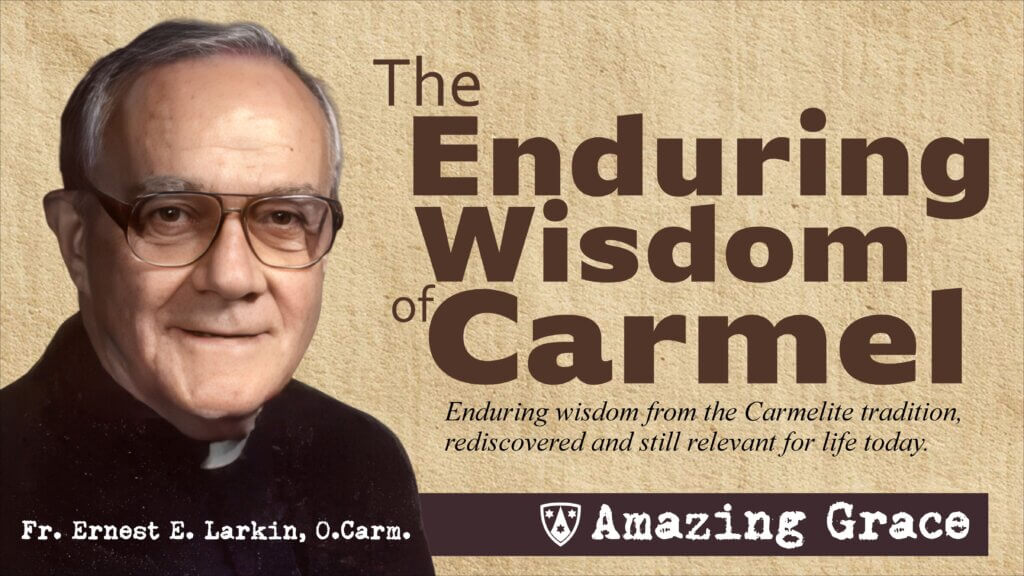
Fr. Ernest Larkin is an American Carmelite theologian and teacher. He gave the keynote address at the first
Australian Catholic Charismatic Conference in Melbourne on 1 June 1974; this article is the text of that address.
“I give thanks to God always for you because of the grace of God which was given you in Christ Jesus, that in every way you were enriched in him with all speech and knowledge . . . so that you are not lacking in any spiritual gift …” (1 Cor 1:4-7). These words were first addressed by Paul to his charismatic converts at Corinth; they are also addressed to us. They are the reason for this First National Australian Catholic Charismatic Conference.
We are here to celebrate what God has done among us. We are gathered to give thanks for being in Christ Jesus, enriched with every spiritual gift. We are also here to pray that the Lord “will sustain (us) to the end, guiltless in the day of our Lord Jesus Christ.” (ibid. 1:8)
Paul’s words of gratitude to God had special significance for the Corinthians. He had evangelized them immediately after his discouraging experience at Athens, where he had tried to meet the pagans on their own ground of philosophical debate. In Corinth he abandoned that tactic and “decided to know nothing except Jesus Christ, and him crucified” (1 Cor 2:2). He preached the Lord, “not in lofty words of wisdom … but in, the demonstration of the Spirit and power, that their, faith might not rest in the wisdom of men, but in the power of God” (1 Cor 2:1,4-5).
Paul could chide these factious Corinthians, these charismatic Christians who seem to have given Paul more gray hairs than any of his other converts: “Not many of you were wise according to worldly standards, not many were powerful, not many were of noble birth; but God chose what is foolish in the world to shame the wise; God chose what is weak in the world to shame the strong…” (1 Cor 1:26-27).
These simple folk, indeed these roughnecks, had come to know the Lord in all the experiential depth conveyed by the Hebraic word “know”. They were transformed by this “knowing” the Lord; they were new creatures, in whom Christ Jesus dwelt as their wisdom, their righteousness, their sanctification and redemption (cf 1:30). The moral of the story was clear: “Let him who boasts, boast in the Lord.” (1:31)
This weekend we are boasting in the Lord. God has done no less among us than he did among the pagan Corinthians. There are not many wise or powerful or highly born among us. Yet he has taken us sleeping Christians and awakened us to the presence of the living Lord; he has made an impersonal Jesus Christ come alive as our personal Saviour; he has made Jesus the real Lord of our lives.
This does not mean we are saints, any more than the immature Corinthians were saints.
Did not Paul complain that they were infants who could only take pabulum and not strong meat (3:1-2)? But it does mean that we are gifted, i.e., charismatic Christians, who exult in God’s loving-kindness, who praise the Lord for his great mercy, who rejoice in the hope that is in us.
But we must not be puffed up. We can fail the test, as did the Israelites of old and perhaps some of the Corinthians; we can fail to hold to our faith. We could fail to be faithful to the original gift; we could fail to realize that Christ Jesus is in us (cf 1 Cor 13:5).
A Beginning
The “baptism in the Spirit” is the entrance into the Charismatic Renewal. It is the beginning, not the end. It is an awakening to the presence of the Lord in our lives, not a final consummation. The “baptism” is a new beginning; but it is only the first installment, not instant sanctity. It is very much like all God’s invitations to divine friendship that are special moments of grace, of which our spiritual tradition speaks. St Teresa of Avila, for example, writes of beginners in the spiritual life: though they are in a sad state and lacking in virtues, God gives them consolations, favors and emotions which begin to move their desires, and occasionally he even brings them to a state of contemplation, though rarely and not for long at a time” (The Way of Perfection, c. 16).
St Teresa goes on to say that the most important matter in such graces is fidelity, which is itself a gift of God. We can be faithful, because God is faithful (1 Cor 1:9). We keep our eyes on him, not underestimating the struggle, but praising and thanking him for the gift of his Spirit. We do this because we have our elder Brother Jesus and we have each other. Our strength is in the power of the Spirit and our fellowship with one another. In these two factors lies the genius of the Charismatic Renewal.
Many Christians reach an impasse in their spiritual life because they become bored, tired and discouraged. In one image of St Teresa, they feel weighted down by “our miserable nature which is like a great load of earth” (Interior Castle, “III Mansions”). The shovel and wheelbarrow of personal efforts are no match for the task, and people lose heart. But there is another way.
Enter Holy Spirit who sweeps away difficulties with the ease of giant earth-moving machinery! He is doing this in the lives of many people today; he is turning them on and giving them a new spirit, a new hope, and a new life. Will-power christians are giving way to Spirit-power christians. Someone has said that the song of the 60’s was “We Shall Overcome”, and the song of the 70’s is “Amazing Grace.” Struggle and effort are still in order, but the source of the power is no longer ourselves, but the Lord. God’s grace and Love and power come into play when we accept our weakness and helplessness. God’s love can work miracles in the humble, the little, the poor people of God. His power is made perfect in infirmity.
This principle is as old as St. Paul, but it is being re-discovered by the Charismatic Renewal. What is new in the Renewal is the recognition that the power of God is especially operative in community, in the fellowship of fraternal love. This is the same power of the Holy Spirit that is made perfect in infirmity, but expressed in another mode. We recognize our need to share, to give and to receive from one another. Somehow this opens us wide to God. We have come, therefore, not only to tune into the Lord directly, praising and thanking him in expectant faith, but also to lean on one another, bearing one another’s burdens.
Ministry Of Friends
The Charismatic Renewal is nothing more or nothing less than a segment of the people of God, moving forward together in the service of god and of each other. The bankruptcy of much of the piety of the recent past is precisely its individualism. We cannot say ‘Jesus is Lord,’ except in the Holy Spirit (1 Cor 12:3). It is becoming increasingly evident that we cannot persevere and grow in the Lord except together in brotherhood with each other in the Lord. Both aspects are works of the Holy Spirit in us. The love of God grows proportionately with love of neighbor, and vice versa.
This humble ministry of friends to each other is an old truth but it may be new to many Catholics. We have long since recognized that the Christian is by definition apostolic, that we cannot keep his faith without sharing it, that whatever we do to the least of his brethren we do to the Lord. But we have been applying these truths to those outside; now we are seeing them at work in our circle of friends, our small faith-community. We are coming to realize that we go to God in small units of the Mystical Body, and without that “little church,” that ecclesiola, we tend to stand still.
We are like spokes on a wheel and the hub is Christ. The closer we get to the centre, the closer we get to each other. A close-knit community, based on our common faith and common experience of the Lord, grows out of personal love for the Lord as a flower from the stem. What builds this community is outgoing love or service. This is to make us what we are. The bonds that unite the members are not mutual attraction or common interests in sports or the arts, although these are not excluded. The one thing necessary is the Lord, and he expresses himself in the fraternal love that marks his presence. This love is Pauline agape or loving service. It is a charity which is “patient and kind, not jealous or boastful, not arrogant or rude; a love that does not insist on its own way or is irritable or resentful, that does not rejoice at wrong but rejoices in the right: a love that bears all things, believes all things, hopes all things, endures all things.” (1 Cor 13: 4-7)
This kind of charity is open-ended, even though it originates and develops best in a small circle of friends. But the circle is not a closed, elitist club. It opens out to the wider community of the parish, the diocese, the church and the world. These are so many concentric circles, whose strength and community lie in their proximity to the centre itself, who is the Lord Jesus. Charismatic communities originate around the hub. But Charismatic Christians long to be an integral functional part of their parish, serving as well as being served in the renewal of the parish, identifying with the parish and gradually losing their own identity by being absorbed as a living cell in the larger body.
The Charismatic communities are not a counter-church or a parallel church.
They recognize their parish priest as their spiritual father in Christ; they long to serve and pray with their chief shepherd of their diocese, their bishop, and to be in loving communion with all the bishops. They are especially devoted to him who has primacy in the church, our beloved holy Father Pope Paul.
This is why the Charismatic movement is not divisive or separatist in the church. Charismatics have consistently begged for guidance and direction from the bishops. They welcome priests into their midst.
May I speak in the first person? . . . We Charismatics do not want to be orphans. God is our Father, Jesus our brother, and we live in the power of the Holy Spirit. But as loyal sons and daughters of the Church, we joyfully acknowledge with Pope Paul that the “ordinary and institutional structure of the church is always the highway by which the Spirit reaches us” (Pope Paul, audience, Feb. 21, 1973). Therefore we want the Charismatic Renewal to be involved with the larger church and the Church to be involved with the Charismatic Renewal. Far from excluding, this conviction includes ecumenical co-operation with our brothers of different communions and traditions and with all men of good will. We seek to worship the Father in spirit and truth and to have an unfeigned charity for all. At the same time we claim our right and our duty to pay heed to “those whom the Holy Spirit has made guardians over us to feed the church of the Lord, which he purchased with his own blood.” (Acts 20:28)
Going Out
We have discussed two elements in the Renewal—the power of the Spirit and the importance of community. One final characteristic of the Charismatic Renewal remains to be noted: it is the personal and corporate outreach that is a fruit and a proof of the Spirit’s presence. The love of God, poured forth into our hearts by the Holy Spirit who is given to us, always seeks ever-wider expression. This love will flow out, but not only among the members of the group; it will spill, over into each concentric circle.
From the beginning brotherly care and concern have been earmarks of the Renewal. Individuals or small groups have reached out like Good Samaritans in the corporal and spiritual works of mercy not only to each other but to those outside. This kind of personalized service is very Christian; it will always be a necessary part of the Church’s apostolate, especially in the ever-widening diaspora where Christian communities become smaller and more separated in alien lands. But the question has been raised more than once whether the Charismatic Renewal has sufficient social concern, whether its corporate apostolate is adequate, or whether it is too introverted and self-serving.
I should like to address this question from two points of view. One is the corporate or social apostolate which the Charismatic Renewal is already exercising. This is the witness of worship and love in a Godless and loveless world. To date, most of the effort expended has been the building up of prayer groups. The thrust has been to form a people of praise and a fellowship of love. As movements in the church go, the Charismatic Renewal is still in its infancy. But already there are visible results in both these areas.
Charismatic prayer groups and communities have witnessed a deep spirit of prayer and of fraternal love. Are not these facts a fulfillment of the words of Jesus at the Last Supper in his priestly prayer: “I in them, and thou in me, that they may become perfectly one.” (Jn 17:23) And why does Jesus pray for this inexpressible unity? … “So that the world may know that thou hast sent me and hast loved them even as thou hast loved me.” Even now the Charismatic communities are testifying to the love of the Father that has appeared in Christ Jesus by the depth of their faith and the truth of their love. This is a witness of inestimable importance.
That being said, the question of the social apostolate of the future remains. In some parts of the world, notably South America, the Charismatic Renewal is deeply involved in social and political action. But elsewhere this has not occurred on any large scale. Should the Charismatic Renewal become more involved in the struggle for justice and peace, in the search for social consciousness? The answer seems to be “Yes, but in due time, as the third stage in emphasis.”
The first thrust of the Charismatic Renewal has been personal conversion, personal relationship with God. The Charismatic Renewal began as a prayer movement. With time, it has become progressively more organized as a community. The organization has taken place through agreements or “covenants,” whereby different roles and mutual rights and obligations are spelled out. This effort marks the second stage of development. It is the effort to undergird the bonds of love with structures that will facilitate the commitment of the members to the groups as a whole. It is a long and laborious process, but a necessary follow-up to halcyon beginnings. This is where most charismatic groups seem to be at today. They are searching to understand headship or authority in the community, interpersonal relationships, and the ordering of the gifts for the building up of the community.
But stage three is on the horizon. The church exists for the larger world and the world’s needs must eventually become the focus of concern This will mark the full maturity of the movement. These three stages—prayer, community, and social action—are not disparate and should not be sealed off from one another. They interpenetrate each other; the efforts to change people and to change society are interconnected. They are the complementary tasks of renewal and reconciliation, which form the theme of the Holy Year declared by Pope Paul VI.
Reaching Out
Renewal begins with oneself. “I know how to reform the world,” said Pope St Pius X; “Let each man begin with himself.” But in our penury we band together and reach out together to the Lord. Brother assists brother in a united front, and behold, we become a people of God! The Kingdom of God is among us.
But it is not enough to think only of ourselves. We reach out to our brothers whom we have not known before, to tasks and hopes and new worlds that will allow the kingdom of God to spread. This is not a religious imperialism or proselytism. It is to create an atmosphere where each man helps his brother discover the thirst for living waters which is in us all. Jesus said: “if anyone thirsts, let him come to me and drink. He who believes in me, as the scripture has said, ‘Out of his heart shall flow rivers of living water.’ Now Jesus said this about the Spirit, which those who believed in him were to receive; for as yet the Spirit had not been given, because Jesus was not yet glorified.” (Jn 7: 37-39)
Today, on the vigil of Pentecost, we await the outpouring of the Holy Spirit. We are like the apostles and disciples before the first Pentecost. You recall the scene at the opening of the Acts of the Apostles. The intransigent apostles were still looking for an earthly kingdom. “Lord, is it now that you will restore the kingdom to Israel?” Jesus answered: “It is not for you to know the times or dates, but you shall receive power when the Holy Spirit comes upon you, and you shall be witnesses for me in Judaea, Samaria, and to the very ends of the earth.” (Acts 1:6-8) A few moments later, as they watched their Master ascend into the heavens, they began to realize that it was they who were to establish the kingdom of God on earth.
But they also had learned the secret: they would receive power when the Holy Spirit came upon them.
We are gathered here this weekend, because we believe in the power of the Holy Spirit. We await a fuller outpouring of that Spirit.
We are converted, but we wish to be more converted still…for this we need the power of the Holy Spirit.
We are a people, the Lord’s people, but we wish to become still more a people of God… for this we need the power of the Holy Spirit.
We are witnesses of the Lord, expressing his love, his salvation, his promises to those who are near and to those who are afar … for this we need the power of the Holy Spirit.
Come Holy Spirit, fill the hearts of your faithful and kindle in them the fire of your divine love.
About Fr. Larkin:
Father Larkin Ernest E. Larkin was born in Chicago on August 19, 1922. He entered Mount Carmel College, Niagara Falls, Ontario as a high school seminarian, and graduated in June, 1939. He made profession of vows in 1940, and graduated from Mount Carmel College with a BA in philosophy, 1943. He was ordained a priest on June 8, 1946. Fr. Larkin’s theological studies at Whitefriars were completed in June, 1947, and he did post-graduate work in English literature at Catholic University during the summers. His graduate studies in theology were completed at the “Angelicum” (St. Thomas University), Rome, and he was awarded the STD in 1954. Larkin was assigned to Whitefriars, the major seminary of the Order, where he served as teacher, spiritual director and, eventually, master of students from 1951 to 1959. In 1959, Larkin was appointed lecturer in ascetical and mystical theology at The Catholic University of America where he continued as assistant and then associate professor until his resignation in 1971. During this period he also taught in the MA program for novice mistresses at St. Mary’s College, Notre Dame, and gave his first paper for the Catholic Theological Society of America. “The Role of Creatures in the Spiritual Life” (1962). He was also consulting editor in the ascetical-mystical area for the “New Catholic Encyclopedia” in which several of his articles were published. During his tenure at Catholic University, Larkin gave addresses at the Conference of Major Superiors of Men of Mundelein, IL, and spoke at several meetings of the Canon Law Society of America as well as The Sister Formation Conference. He was active within his own Carmelite Community, serving on the provincial council from 1966 to 1972, with special responsibilities in the area of spiritual life. He was elected delegate to the General Chapter in Rome in 1965, 1968, 1971 and 1983. Physical health problems forced a medical leave from the University in February, 1970. Larkin was invited to be theologian-in-residence in the newly-created diocese of Phoenix, AZ, and after his leave of absence for the academic year, 1970-1971, Larkin resigned from Catholic University. In 1972, Fr. Larkin co-founded Kino Institute which was established as the Phoenix Diocesan School of Adult Religious Education for Clergy, Religious and Laity. He was the first president and helped frame the Institute’s goals and purposes. Enrollment grew to 1780 students in two years.
During the 1970’s, Larkin gave many retreats and workshops throughout the country and abroad including the Far East. He taught summer school at St. Louis University (1978) and Creighton University, Omaha (1979), and was the bishop’s liaison with the Catholic Charismatic Movement in Phoenix.
Several of Larkin’s papers were published during this period, and the ground-breaking book, “Spiritual Renewal of the American Priesthood,” commissioned by the Bishop’s Conference, was published in 1973. Larkin was co-editor and wrote the final draft. In the 1980’s, Larkin’s ministry included renewal programs at Notre Dame for “Retreats International” and the “Continuing Education Program for Clergy” as well as ongoing formation programs for Carmelites in Rome. He was consultant for the spirituality section of the international review, “Concilium,” and for the “Center for Human Development,” Washington, DC. These years also saw the publication of two books by Father Larkin, “Silent Presence” (1981, revised and enlarged in 2001), a discussion of discernment as a process and a problem, and “Christ Within Us” (1984), a book of essays exploring the contemporary experience of Christ, Church and self.
In 1982, Larkin was founding member of the “Carmelite Forum,” a group of scholars from both observances engaged in studying and promoting Carmelite Spirituality. Their annual seminars, held at St. Mary’s College in Notre Dame, have drawn clergy and laity from all parts of the country. Larkin’s presentations have been published in periodicals and collections of the seminar as well as in audio cassettes. (ICS Publications) “The Carmelite Forum” at St. Mary’s in Notre Dame June, 2000. It was published by Paulist Press with other essays from that seminar in “Carmelite Prayer,” a festschrift honoring Fr. Ernie, a pioneer in the study of Carmelite Spirituality.
His paper “Jubilee Spirituality” was awarded first prize from the Catholic Press Association for “Articles on Spirituality for the year 2000.”
Father Larkin continued to teach, give retreats, participate in workshops and write until his death in 2006.
The Carmelites of the Province of the Most Pure Heart of Mary, in allegiance to Jesus Christ, live in a prophetic and contemplative stance of prayer, common life, and service. Inspired by Elijah and Mary and informed by the Carmelite Rule, we give witness to an eight-hundred-year-old tradition of spiritual transformation in the United States, Canada, Peru, Mexico, and El Salvador, and Honduras.
Please consider supporting their mission
https://carmelitemedia.tiny.us/supportpcm
to make a financial donation.