

Click on any arrow marker on the sculpture to read details about the area it points to.
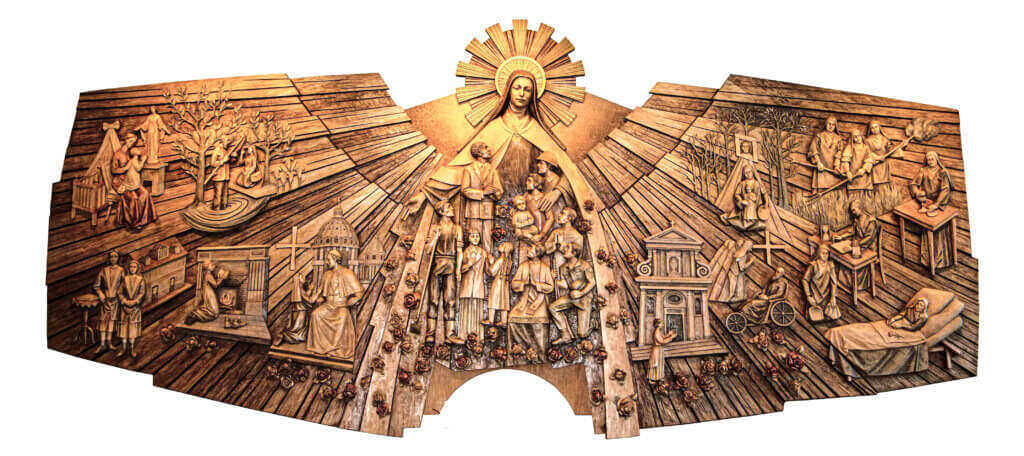
Baby Thérèse being dedicated to Mary Victorious (Our Lady of Grace) by her mother. This is significant because it was through the smile of this statue that Thérèse experienced the healing of her mother-abandonment wounds.
Here we come to her father fishing and Thérèse having her mystical experience and insight that the beautiful wild flower gave glory to God not by being noticed but simply by being.
The young Little Flower with Pauline, her older sister and “second mother” in Lisieux after their mother died.
Her fireplace Christmas conversion when she awakened to the spiritual truth that “life is not about you, but about loving others” which transformed her life. And her famous audience with the Pope wherein she asked him to intervene and grant that she become a Carmelite Nun before the regular time. Thérèse goes straight to the top, which is why we trust her intercessory power.
Here we come to Thérèse's entrance into the Lisieux Carmelite Monastery, exclaiming with great joy: “I am here forever and ever!”
The young nun at the Shrine of the Holy Face of Tours; she took the religious name: St. Thérèse of the Child Jesus and the Holy Face. This is reflected in her Little Way spirituality: “be like a child” and always seek the face of Jesus, especially amid suffering.
All four Martin girls who became Carmelite Nuns: Marie, Pauline, Thérèse and Celine, and their father, Louis, who was wheelchair bound in his later years because of a stroke.
Thérèse and two other sisters are seen “haying” – the Carmelite Monastery was self-sustaining and everyone had to pitch in.
Thérèse's responsibility as sacristan and to prepare all the elements of Eucharist.
Thérèse writing her “Mercies of God” autobiography, prompted by one nun who said: “what will we say about her when she dies, she is so ordinary.” Thérèse's sister, and now Prioress, Pauline - Sr. Agnes, asked her to write what was going on in her life. [I note here that this is the one mistake of this wall relief – she never had a standing desk, only a lap desk.] These writings would eventually become famous as the “Story of A Soul” - and the only reason we know of God's extraordinary actions in her simple life.
In the final image, we find Thérèse in the infirmary. She spent 18 months of incredible physical and spiritual darkness in the infirmary learning to surrender to God in trust and confidence, promising to spend her heaven doing good on earth. Thérèse died on September 30, 1897, at age 24, always believing that God was faithful.
The Life of Thérèse Sculptural Wall Relief
The Wall Relief weighs several tons which required the reinforcing of the Shrine wall to support it. Central to the relief is a depiction of St. Thérèse as Patroness of the Missions, embracing, in her shower of roses, the peoples of the world for whom she devoutly prayed, especially families, children, soldiers, and priests.
The National Shrine Museum of St. Thérèse in Darien, Illinois, is home to the largest wood carving of a religious nature in North America, depicting the life of St. Thérèse of Lisieux… but the magnificent Lindenwood carving is as paradoxical as it is beautiful.
Our “little flower” Carmelite Saint, known for her “little way”, wished to be humble and hidden but continues to have a strong and intensely visible presence among millions of friends, followers, and fans. Several Popes refer to her as the “Greatest Saint of modern times.”
The original National Shrine to St. Thérèse – notably, the first such shrine – began at St. Cyril’s Church in Chicago in 1923, as devotion to the Little Flower was growing. Due to her popularity, the Tuesday novenas drew thousands of devoted friends which necessitated the shrine being relocated to the more spacious St. Clara’s Church, also in the Woodlawn neighborhood of Chicago. During this time, relics and personal effects of the newly canonized Saint (she was canonized in 1925) were shared with the Carmelite Province of the Most Pure Heart of Mary from the Carmelite Nuns of Lisieux in gratitude for the financial and prayerful support the Province had provided for Thérèse’s beatification and canonization.
Over time the crowds diminished and in 1975 St. Clara’s was devastated by a massive fire which effectively shut down the shrine. Thankfully, most of the relics and effects were not severely damaged, but some saw these events as the end of the devotion – truly, the end of an era. The salvaged relics and effects were taken to the Aylesford Carmelite Priory in Darien, Illinois, about 25 miles south of the city, to be stored.
This, however, was not the end of the story. Like the Phoenix rising from the ashes, from fire sprang forth new opportunities for life.
A devoted Lay Carmelite left the Carmelites a bequest in her will to build a shrine to the Little Flower. The gift was used to build the new shrine in Darien on the Aylesford Carmelite campus. Fr. Terry Sempowski, then director of the Little Flower Society, oversaw the design and construction, making every effort to be faithful to Carmelite spirituality and to Thérèse’s “little way.”
Conrad Schmitt Studios of Milwaukee was commissioned to design both an expansive stained-glass window of the Ascent of Mount Carmel and a sculptural wall relief of the life of Thérèse. The wall carving, made of Lindenwood, was carved by Demetz Studios in Ortisei, Italy. It is reported to have taken 18 months.
The new shrine was dedicated on November 1, 1987.
by Fr Bob Colaresi, O.Carm. | Originally published in Carmelite Review 59|2 [2020]
THÉRÈSE MARTIN was born at Alençon, France on 2 January 1873. Two days later, she was baptized Marie Frances Thérèse at Notre Dame Church. Her parents were Louis Martin and Zélie Guérin. After the death of her mother on 28 August 1877, Thérèse and her family moved to Lisieux.
Towards the end of 1879, she went to confession for the first time. On the Feast of Pentecost 1883, she received the singular grace of being healed from a serious illness through the intercession of Our Lady of Victories. Taught by the Benedictine Nuns of Lisieux and after an intense immediate preparation culminating in a vivid experience of intimate union with Christ, she received First Holy Communion on 8 May 1884. Some weeks later, on 14 June of the same year, she received the Sacrament of Confirmation, fully aware of accepting the gift of the Holy Spirit as a personal participation in the grace of Pentecost.
She wished to embrace the contemplative life, as her sisters Pauline and Marie had done in the Carmel of Lisieux, but was prevented from doing so by her young age. On a visit to Italy, after having visited the House of Loreto and the holy places of the Eternal City, during an audience granted by Pope Leo XIII to the pilgrims from Lisieux on 20 November 1887, she asked the Holy Father with childlike audacity to be able to enter the Carmel at the age of fifteen.
On 9 April 1888 she entered the Carmel of Lisieux. She received the habit on 10 January of the following year, and made her religious profession on 8 September 1890 on the Feast of the Birth of the Blessed Virgin Mary.
In Carmel she embraced the way of perfection outlined by the Foundress, Saint Teresa of Jesus, fulfilling with genuine fervour and fidelity the various community responsibilities entrusted to her. Her faith was tested by the sickness of her beloved father, Louis Martin, who died on 29 July 1894. Thérèse nevertheless grew in sanctity, enlightened by the Word of God and inspired by the Gospel to place love at the centre of everything. In her autobiographical manuscripts she left us not only her recollections of childhood and adolescence but also a portrait of her soul, the description of her most intimate experiences. She discovered the little way of spiritual childhood and taught it to the novices entrusted to her care. She considered it a special gift to receive the charge of accompanying two “missionary brothers” with prayer and sacrifice. Seized by the love of Christ, her only Spouse, she penetrated ever more deeply into the mystery of the Church and became increasingly aware of her apostolic and missionary vocation to draw everyone in her path.
On 9 June 1895, on the Solemnity of the Most Holy Trinity, she offered herself as a sacrificial victim to the merciful Love of God. At this time, she wrote her first autobiographical manuscript, which she presented to Mother Agnes for her birthday on 21 January 1896.
Several months later, on 3 April, in the night between Holy Thursday and Good Friday, she suffered a haemoptysis, the first sign of the illness which would lead to her death; she welcomed this event as a mysterious visitation of the Divine Spouse. From this point forward, she entered a trial of faith which would last until her death; she gives overwhelming testimony to this in her writings. In September, she completed Manuscript B; this text gives striking evidence of the spiritual maturity which she had attained, particularly the discovery of her vocation in the heart of the Church.
While her health declined and the time of trial continued, she began work in the month of June on Manuscript C, dedicated to Mother Marie de Gonzague. New graces led her to higher perfection and she discovered fresh insights for the diffusion of her message in the Church, for the benefit of souls who would follow her way. She was transferred to the infirmary on 8 July. Her sisters and other religious women collected her sayings. Meanwhile her sufferings and trials intensified. She accepted them with patience up to the moment of her death in the afternoon of 30 September 1897. “I am not dying, I am entering life”, she wrote to her missionary spiritual brother, Father M. Bellier. Her final words, “My God…, I love you!”, seal a life which was extinguished on earth at the age of twenty-four; thus began, as was her desire, a new phase of apostolic presence on behalf of souls in the Communion of Saints, in order to shower a rain of roses upon the world.
She was canonized by Pope Pius XI on 17 May 1925. The same Pope proclaimed her Universal Patron of the Missions, alongside Saint Francis Xavier, on 14 December 1927.
Her teaching and example of holiness has been received with great enthusiasm by all sectors of the faithful during this century, as well as by people outside the Catholic Church and outside Christianity.
On the occasion of the centenary of her death, many Episcopal Conferences have asked the Pope to declare her a Doctor of the Church, in view of the soundness of her spiritual wisdom inspired by the Gospel, the originality of her theological intuitions filled with sublime teaching, and the universal acceptance of her spiritual message, which has been welcomed throughout the world and spread by the translation of her works into over fifty languages.
Mindful of these requests, His Holiness Pope John Paul II asked the Congregation for the Causes of Saints, which has competence in this area, in consultation with the Congregation for the Doctrine of the Faith with regard to her exalted teaching, to study the suitability of proclaiming her a Doctor of the Church.
On 24 August, at the close of the Eucharistic Celebration at the Twelfth World Youth Day in Paris, in the presence of hundreds of bishops and before an immense crowd of young people from the whole world, Pope John Paul II announced his intention to proclaim Thérèse of the Child Jesus and of the Holy Face a Doctor of the Universal Church on World Mission Sunday, 19 October 1997.
source: vatican.va
The sculpture hangs in The National Shrine Museum of Saint Thérèse on the Darien Campus at 8501 Bailey Road, Darien, IL, 60561, and is open every day of the week from 10:00 AM to 4:00 PM.
Every weekday, Monday through Friday, the Eucharist is celebrated on the Campus in the National Shrine of Saint Thérèse at 11:30 AM.
During the year there are large prayer experiences including St. Therese’s Feast Day (October 1st), Christmas at the Crib, The Station of the Cross and the Feast Day of Our Lady of Mount Carmel.
Pilgrimage groups of 20 or more can arrange a special guided day or overnight of prayer and communion with St. Therese, by calling 800-647-1430.
Museum Website: https://www.littleflower.org/national-shrine-and-museum-of-st-therese/visit-the-national-shrine-of-st-therese-campus/
Society of the Little Flower Website: https://www.littleflower.org
Carmelite Gift Shop (located in the Museum building) Website: https://carmelitegiftshop.org/
Carmelite Spiritual Center (located on the Darien Campus) Website: https://carmelitespiritualcenter.org/
The Carmelites of the Province of the Most Pure Heart of Mary, in allegiance to Jesus Christ, live in a prophetic and contemplative stance of prayer, common life, and service. Inspired by Elijah and Mary and informed by the Carmelite Rule, we give witness to an eight-hundred-year-old tradition of spiritual transformation in the United States, Canada, Peru, Mexico, and El Salvador, and Honduras.
Please consider supporting their mission
https://carmelitemedia.tiny.us/supportpcm
to make a financial donation.