
Living Carmelite Spirituality Today
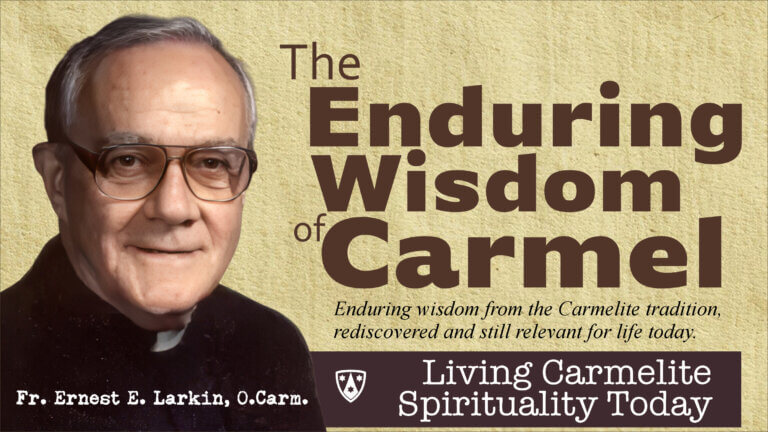
Carmelite spirituality means allowing prayer to transform how we love and serve in everyday life. This means living Christ’s death and resurrection: dying to selfishness and becoming more open to God and others.
Connect prayer with daily life. Keep prayer and the Eucharist central, then carry that offering into your work, relationships, and service.
Make yourself available to others. Giving people your attention, patience, and practical care is itself a demanding form of self-denial. His instruction is to “love people as they are.”
Recognize God in ordinary encounters. Union with God grows through faithful, loving action, even when prayer brings no strong feelings or conscious experience of God’s presence.
Live Mary’s everyday yes. Marian devotion finds its fullest expression in imitating her openness to God’s will and her quiet faithfulness in ordinary circumstances..
Fr. Ernest E Larkin, O.Carm. (1922-2006)
Fr. Ernest Larkin was an American Carmelite theologian and teacher
One of the insights of the modern biblical and liturgical movements is to see Christian life in terms of the Paschal Mystery. The Paschal Mystery is Christ’s death and resurrection, his “pasch” or passage out of this world to the Father (Jn 13: 1). The Paschal Mystery is a key truth of our faith; it is, in a sense, our whole faith. The heart of the bible and the liturgy is the proclamation of the death and resurrection of Christ. Christ “died for our sins and rose again for our justification” (Rom 4: 25). The Easter preface points up this double aspect of our redemption in graphic fashion: “By dying He destroyed our death and by rising He restored life to us.” The Paschal Mystery thus has a twofold repercussion in our lives.
Our passage to the Father in union with Christ—for He is the “Way”—consists in breaking through the thick crust of sin and selfishness that closes us off from God and from each other (this is our death) and rising to community life with the Father, to fellowship with God and the saints. We die to the old and live to the new. With Christ we die to the world which does not know God or breathe His life.
Such death is only the negative side of our new life in Christ. In His resurrection Our Lord becomes the life-giving Spirit, who unleashes the divine life into the world, who animates, enlivens, and transforms all the members attached to Him. Our life of grace is our participation in the resurrection.
Baptism begins this death to sin and life in God. St. Paul has a famous description of Baptism in the sixth chapter of his letter to the Romans. When the Christian is baptized, Paul writes, he goes down into the tomb with Christ and leaves his old self, his sins and his selfishness there. But he comes out of the tomb a new man, breathing the new life of grace. Baptism is thus a symbolic expression of our participation in the Paschal Mystery. The other sacraments too are key expressions of this same death to sin and openness to God and one’s fellows.
Indeed every act of the Christian, every actualization of grace in our lives manifests the double movement. Every time we fulfill God’s will in our daily life we die to the closed world of self and live for God. Sometimes the death aspect is more in evidence, as when we accept sickness or the struggle against temptation or the Cross in any form. At another times the life aspect stands out, as when we experience the joy of the Lord’s service or the rewards of fraternal charity. Ultimately the new life in Christ is nothing other than a life of charity. This is the Christian’s living of the Paschal Mystery.
Carmelite Spirituality
How does Carmelite spirituality fit into this framework?
At first sight one might wonder if it fits at all. Carmelite spirituality is usually put in terms of three characteristic practices: prayer, self-denial, and devotion to Our Lady. How can this program be integrated with the concept of Christian life as death and resurrection?
The answer can be found in one of the oldest documents on the Order’s spirituality, The Institution of the First Monks, dated in the 14th century. There the Order’s purpose is stated to be twofold:
The goal of this life is twofold. One part we acquire with the help of divine grace by our efforts and virtuous works. This is to offer to God a holy heart, free from all stain of actual sin.
The other part of the goal of this life is granted to us as a free gift of God: namely, to taste somewhat in one’s heart and experience in the soul, not only after death but even in this mortal life, the intensity of the divine presence and the sweetness of the glory of heaven.
How well this twofold aim corresponds with death and resurrection in Christ, The “pure heart” free from sin of the Institution, self-denial, is the Carmelite formulation of death in Christ. The mystical encounter of the Institution, the prayer and union with God, is the specific Carmelite expression of resurrected life. Carmelites would go to the heart of the matter in their life with God: they would walk with Him, they would find and taste His presence in every corner of their lives.
Marion Devotion
But what of the third element, devotion to Our Lady? How does the Marian character of the Order fit into this picture? What has devotion to Mary to do with the death-resurrection theme?
It may surprise some that Mary is not mentioned in the Order’s purpose in the Institution, when we pride ourselves on being totally Marian. The explanation is simply this: we are primarily Marian insofar as we live the double directive of the Institution.
The truest devotion to Mary consists in duplicating her life. Every Christian has the same vocation as Our Lady, whose whole life is summed up in one word, “fiat,” “Thy will be done.” Every Christian spirituality, therefore, must be Marian. Carmelites would stress this fact.
Our Marian character is not something accidental, extrinsic, something plastered on our Christian life. Our Marian character is essential to us; it is our life. The more Marian we are in the truest, deepest sense, the more Christian we are, and the more fully we are living our Carmelite vocation. Certainly we call on our Blessed Mother for help, we trust her constant care, we endeavor to honor her by proclaiming her privileges and praise. But even as devotees and children of Mary, let alone as her brothers and sisters, our proper title, we have one main work to do. It is her work: to hear the word of God and keep it. This is to live by charity. If we do this, we will be entirely Marian; thoroughly Carmelite, and perfectly Christian.
Thus does Carmelite spirituality fit the context of Christian life. Any Order, any spirituality in the Church singles out special aspects of the general plan of salvation revealed by God and constructs its own way to God. We Carmelites can be grateful that our forefathers, under the guidance of the Holy Spirit, chose very essential elements for special stress. We are Christians first, and Carmelites second, certainly; but we need make no apology for our Carmelite spirit, since as Carmelites we emphasize the very essentials of death and resurrection in Christ. We are, moreover, men and women of our time, who live by a rule and a spirit that is thoroughly in accord with the way the Holy Spirit is breathing in the Church today. We live the Paschal Mystery.
Spirituality in Practice the Liturgy
How can the Carmelite put this spirituality into practice? Is there a practical program to help the Carmelite fulfill the double task of her vocation ?
The first and most important implementation of this spirituality is participation in the liturgy, and I mean here especially the Mass. The liturgy is, without doubt, the chief expression of our participation in the death and resurrection of Christ. It is, as the Constitution on the Liturgy of Vatican II explains, “the summit toward which all the activity of the Church is directed, the fount from which all her power flows” (n. 10). As the summit, the Mass is the highest expression of our living the Paschal Mystery.
In each Mass we attend we protest in the clearest and most effective terms-in union with Christ our Head and with the whole people of God-that we are dead to sin and living entirely to God. Each Mass is an experience that sums up and signifies (and causes) “the dying of Jesus which we bear about in our body so that the life also of Jesus may be made manifest in our mortal flesh” (1 Cor 4: 10-11) We come to Mass to offer our lives to God and we return to our daily round to live that offering. This is the rhythm of Christian life, so that it is always lived between two Masses.
Charity
How do we apply Carmelite spirituality between our two Masses? In two ways, the cultivation of fraternal charity and the practice of the presence of God. Both of these are reducible to charity.
Charity means being disponible, being available, being at the beck and call of other people. Being available signifies that you are not closed in on yourself, isolated in insecurity or indifference.
Insecure people are hostile because they are afraid of other people. They see others as enemies, hence they become aggressive, on the defensive, mean. They may not mean to be mean. You hear it said: “So-and-so doesn’t mean to be nasty.” But So-and-so is nasty. Why? Often because of insecurity. Anxious and fearful, the insecure person often strikes out blindly at his fellows.
An even greater enemy of mutual love, however, is indifference. The opposite pole of love is to be so wrapped up in yourself that you hardly know that there are other people around. Every degree of indifference is a corresponding degree of lack of love. Insecurity and indifference, then, make it impossible to be open and disponible to others.
The answer to both problems is charity. If the insecure and the indifferent would recognize the charity of God in their hearts, if they would take the first step of convincing themselves that God loves them, that other people are not their enemies but their friends, that all men belong to the family of God, they would be on their way to being thoughtful, generous, unselfish Christians. Selfishness makes us unable to recognize others as persons. Selfishness’ makes us refuse to recognize our brothers. Selfishness consists in living as if we ourselves are the center, in fact, the single member of our kind. Charity on the other hand, means that we recognize many “other selves.” Every “thou” we meet is another “I” or at least seen as one with ourself. Every “thou” is in fact Our Lord, because whatever is done for the least of His brethren is done for Him (Mt 25: 40).
A Carmelite who will practice such charity need not go out looking for penance and self-denial. She will already be practicing the kind of charity recommended to St. Therese of Lisieux by Father Pichon, one of her spiritual directors. He gave her a word of advice that to her mind was sufficient to construct a whole spirituality: “Love people as they are.”
Love people as they are, not as they should be, or as we would like them to be, but as they are. This is what it means to be disponible to others.
The Presence of God
The second element of Carmelite life has to do with prayer. We Carmelites are serious about our vocation of prayer. We would walk with God through life; we would stand before Him like our father Elias; we would see the world suffused with the divine, bathed in his Precious Blood. But how shall we become aware of God’s presence? How can we develop a realization that Christ is all about us?
The answer is disarmingly simple. It is again to practice charity. The charity of Christ opens our heart to others, but at the same time it opens our heart to the Divine Presence. A down-to-earth charity will purify: it will drive out pettiness and sinfulness, and we will see Christ revealed in our neighbor and in our own life.
People are realizing today that God is not only “up there” or “out there,” but that He lives deep within our finite little world. He is in this world we see and touch, and we are in the same world and nowhere else. If we don’t find Him here, we shall not find Him anywhere.
Union with God does not consist in imagining God up in heaven or out beyond space and holding imaginary conversations with Him by telephone. Real union is not achieved by our understanding that the transcendent God is immanent in the universe. We attain union with God when our wills are attuned to His, when we are keeping the commandments and loving our neighbors. We are present to God and God is present to us, in other words, in charity. “He who keeps his commandments abides in God, and God in him,” says the Apostle of Charity (1 John 3: 27). “And everyone who loves is born of God, and knows God… for God is love” (1 John 4: 7-8). This is why we say we meet God in the concrete daily actions of our Christian lives. Notice, our psychological consciousness is not at all the criterion. We may have no conscious experience of God, no feeling of His presence, but in doing His will we know that we are in contact with Him.
I am by no means suggesting that we abandon the practice of formal prayer, including the usual practice of the presence of God, in favor of keeping the commandments or practicing fraternal charity. We must do all these things, for each has its place. I am merely saying that we must broaden our view of the presence of God and see it, not only as an isolated act of conscious reflection, but as implicit is every act of charity. The prayer of the Carmelite should not be identified with words, or with feelings, or with experience, even “the tasting of the intensity of the divine presence and the sweetness of heavenly glory.” At most such consciousness is only a sign of deeper union.
The essential of the practice of the presence of God is the will to be in contact with God, the will to be with God and walk with Him, independently of whether or not one experiences the overflow in sensible or spiritual consolations. If we are trying to do God’s will, trying to love God and our neighbor, trying to pray according to our rule of life, we are building up a deep sense of God’s presence in our world and one day we may well achieve the reward held out by the Institution.
Mary the Model
The two aspects of our Christian and Carmelite life, therefore, find their fulfillment in charity. This is reassuring—we know that our inquiry has been on the right track—because charity is the touchstone of the truth. It is also the core and heart of every spirituality in the Church.
But our application is particularly Carmelite too, because it is Marian. Mary was the holiest of God’s creatures, because she was the purest. Hers was the most perfect “yes” to God’s will. Everything she did was filled with the love of God, transparent of the orientation of her being. There was nothing of a self-in-opposition to God in anything that she did: no wonder she found God in all things, in every action, in every encounter with her neighbor.
At the same time her life is so ordinary. The Gospel is strangely silent on details. She is the quiet but faithful handmaid of the Lord, who does the will of the Father whatever it may be. Particulars are unimportant.
God matters, and therefore charity and self-forgetfulness matter.
This is our life as Carmelites. Whatever we do—whether nuns of the Second Order or sisters of the Third Order—is unimportant in itself. What is important is that we learn to die to self and live to God in perfect response to the calls of the Holy Spirit.
If you would like to support the mission of the PCM Province of Order of Carmelites, donations may be made online by visiting
https://carmelitemedia.tiny.us/supportpcm