
The Enduring Wisdom of Carmel: Prayer as Presence
“Genuine prayer begins in the real world, in our real selves, with all the relationships with other people and our tasks in life. Prayer is not an escape. It is contact with God where He comes to us. That means real life, in the depths of our own identity, in our human contacts with one another.”
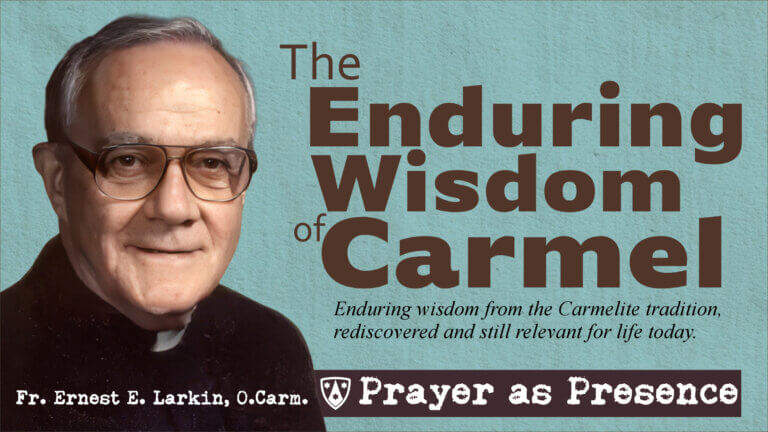
Fr. Ernest Larkin is an American Carmelite theologian and teacher.
Presence may mean presence in or presence to. In the first case you have spatial presence, or place. I am in this room; God is in the church. But what does this mean with God? God is not a body, hence he cannot be in place spatially. Solomon turned over this problem at the dedication of the temple. If the universe cannot contain you, Yahweh, he prayed, how can you “dwell” in this temple? Yahweh’s answer was that He would inhabit the temple, insofar as he would be there listening to the prayers of His people, and, with a certain mutuality, they would be mindful of His will (1 Kings 8:27; 9:3-9).
Present to God
The presence of God, in other words, is presence to. It is personal and dynamic. Dynamic, because God is present where He acts; personal, because He is an intelligent agent, a person who loves, and He is present where He consciously and lovingly acts.
The schoolboy watching the clock in the classroom is present in the room but not to the teacher. The youthful nun Teresa of Jesus watching the hourglass during the time of mental prayer was in the chapel but less than wholly present to the Lord. On the other hand a boy and a girl may grow up next door to each other and hardly notice each other; one day they fall in love and henceforth are intensely present to each other even though the young man goes off to service or the girl moves to another city. Personal presence, whether with man or with God, is more an experience than a physical fact. The soul, says St. Thomas, is more present where it loves than where it animates.
God is always and everywhere present to the world. He is not only the ground of being and the principle of life; He is father, lord, bridegroom, friend. He is the Father calling all men to Himself (each one by name) in the Son by the power of the Holy Spirit. He is the Deus operarius of St. Ignatius, God working in the universe, bringing all things to fulfillment in Christ.
When we reciprocate that presence, we have prayer. God becomes a presence to us just as we are a presence to Him. Prayer, in other words, is mutual personal presence, mutual presence to, hence presence with Someone. It is encounter, meeting, contact. It is presence offered and received, call and response, invitation and welcome, gift and acceptance. Prayer is presence in love: my beloved to me and I to my beloved (Cant. 7, 16).
God is presence
This concept of prayer takes away the immense burden of objectifying and defining God—an impossible task in any case—and leaves God on the very real, though non-conceptual level of “Thou.” The Father or Christ or the Holy Spirit is a loving presence, suffusing everything like the atmosphere, like background music or a divine milieu in which we live and move and have our being (Acts 17:28). But God remains a person. He is not reduced to a dimension of the universe; He is a Presence evoked by experience but beyond any sign or symbol, part of life but beyond all life, the beginning and end and yet wholly transcending man’s highest possibilities. In a word He is real not because He is grasped by the categories of the mind but because He is “there.” He is not a measurable and definable object; at best the imagery and the concepts we use to identify Him arc only the poor translation of a love which defies adequate language.
A new reality comes into being through prayer, and that reality is the prayerful person. The prayerful person is a religious presence; he emits the “vibrations” of one whose life is with God. The Ultimate, the Transcendent, the Sacred, the Beyond in the midst of life—these are what stand out as the concern, the orientation and the preoccupation of the religious man. Such are contemplatives. Such are the mystics, such are all truly religious people who structure their whole lives around this God-value in human existence.
Both knowledge and love are involved in the process of developing religious presence. But love is the key. God is a presence to me when I know Him by way of love. It is a truism in theology to say that grace gives a “quasi-experiential” knowledge of God and that contemplation is an “experience of God.” Historical investigation has shown that for the medieval theologians the experiential quality of the Christian’s knowledge of God came from the affections. Mystical experience is a love experience. Presence is revealed, not by knowing a great deal about the other person, but in a loving person-to-person encounter.
The problem of talking about God
Conceiving prayer as presence is rephrasing old truths, perhaps in categories that are somewhat new. What is the value of this formulation of prayer? In my opinion prayer as presence is a particularly happy formulation for two reasons: (1) it supplies a language; (2) it suggests a program for cultivating a life of prayer in a contemporary setting.
First, it solves the problem of language. Talking about God meaningfully has always been a problem, because God lives in a different sphere from man; He dwells in inaccessible light (1 Tim. 6, 16). For us to speak of Him at all demands constant adjustment, because He is more unlike than like us. But today the problem is aggravated by the cultural shift, the changes in patterns of thought and life that have made us uneasy with the older formulations about God and religion. We have yet to develop new acceptable forms. Signs of this cultural transition in religion are the sense of God’s absence instead of His presence in our world, “death of God” theologies, the cosmic dark night that seems to affect all levels of religious experience even as man continues to conquer technical aspects of the universe by flights to the moon. We live in a godforsaken epoch because our inherited forms and structures do not correspond to the way we think and feel about God and the world of faith. The thrust and dynamism of our faith and charity are on different wave-lengths from the images and concepts of the past.
God is in our world, no doubt; He is immanent. But He is not our world or any part of it; He is totally transcendent. How can we express this ineffable Being? He is “out there” in one sense, but He is not just alongside other causes and created reality; He is the within of all things, the dynamic center of life, manifesting Himself in people, events, history.
The double reality of God
The concept of presence seems to capture this double Reality of God. It safeguards the divine reality, even as it locates God in the human condition. Signs and symbols become one with His Presence. God remains God, but He is recognized in man—in oneself, one’s neighbor, one’s world. The sharp distinctions of more intellectualist, static categories give way to person-to- person understanding and personalist themes.
Abraham Maslow connects the ability to unite opposites and to hold together both ends of the spectrum with the achievement of a developed personality. He writes:
It is as if less developed people lived in an Aristotelian world in which classes and contrasts have sharp boundaries and are mutually exclusive and incompatible. For example, male-female, selfish-unselfish, adult-child, kind-cruel, good-bad. But seen by self-actualizing people as a fact is that ‘A’ and ‘not A’ interpenetrate and are one, that any person is simultaneously good and bad, male and female, adult and child. One cannot place the whole person on a continuum only as an abstract aspect of a person.
Mystics have lived the coincidentia oppositorum. The fact is that God and man “interpenetrate.” God- talk and man-talk are mutually inclusive and one discourse is impossible without the other. God is immeasurably above and beyond us, but at a certain point we are more God than ourselves. The concept of presence allows us to live with this mystery. Presence moves the discourse to the level of person and to the thrust of love and knowledge together, whereas some other definitions of prayer tend to over-objectify in a rationalistic fashion. Presence, in other words, is less cerebral and more total, more personal, more affective. We do not have to have clear ideas about God to know Him profoundly. Love is a far better entrée to God’s intimate life than much knowledge, as the saints and mystics throughout the centuries have emphasized.
A program of prayer in our time
But the more important contribution of the concept of prayer as presence is that it suggests a program for prayer in our time. Specifically it suggests how a life of prayer begins, how it develops, and where it tends.
First, this concept reminds us that genuine prayer begins in the real world, in our real selves, with all the relationships with other people and our tasks in life. Prayer is not an escape. It is contact with God where He comes to us. That means real life, in the depths of our own identity, in our human contacts with one another. God is not an abstraction which we conjure up by mental gymnastics. Nor does He appear among us in theophany, as He did in the Old Testament. He has come in Christ the Man, and, as St. John of the Cross said, He said all He has to say to us in Christ. But Christ is not detached from His members; He lives on in the human world, in His members. This is to say that God’s presence is diaphanous today, shining in the face of Jesus as Jesus is refracted in the faces of His members, especially in the anawim of our time. How Christian are Dostoyevsky’s words: He who would find the face of the living God should not seek Him in the empty firmament of his mind, but in human love.
We could indeed make a strong biblical and theological case for God’s self-revelation as presence. When Moses asked Yahweh’s name, He received the answer: “I will be there.” This is God’s name. He is a Presence. He is a Presence in the Temple and later in the synagogue, because He offers Himself there and is received there: He possesses the place. In the New Testament, when God is worshipped in spirit and truth, the persons and communities become His temple. He possesses them as the Presence that gives light and life to their lives. The Indwelling is the personal side of grace: to have grace (habere gratiam), said St. Bonaventure, is to be had by God (haberi a Deo).
How prayer develops
How does presence indicate the lines for developing prayer in one’s life? The answer lies in the nature of personal presence. Presence is a developmental reality, not a once-for-all achievement. Like friendship, like love, it grows—or recedes—with the growth of openness and love. This is to say simply and categorically that presence grows with maturity.
What is maturity if not the healthy ability to transcend oneself in knowledge and love, to get out of one’s petty self-enclosure and encounter objective reality, especially persons and ultimately God. This is what self-actualization self-realization, maturity are all about. This is true “self-fulfillment,” the kind of self-fulfillment of which Paul VI spoke in The Development of Peoples. There the Pope said that we have as much obligation to develop ourselves as we have to save our souls. He spoke of Gospel self-fulfillment that paradoxically achieves its development by giving, by renunciation.
We are at the heart of the contemplative vocation with this consideration. Contemplatives exist to pray, to become Christ at prayer. But paradoxically this is the same as saying that they exist to become themselves. Thomas Merton put this beautifully in one of his last interviews. He identified growth in prayer with personal growth. “All we can do,” he said, “is try to honestly be ourselves.” The self in question, of course, is not our illusory self, but our real self, which possesses itself by giving itself. “What truly matters is not how to get the most out of life, but how to recollect yourself so that you can fully give yourself.”
Recollection is total presence
The note of realism characterizes this advice. Prayer demands renunciation, but involvement and commitment to others as well. The contemplative goes out to others in depth rather than in numbers of people, seeking the Christic presence in the world in its source, Christ Himself as person, rather than in His multiple manifestations as person, rather than in His multiple manifestations in the children of men. But the bias or emphasis can never become an exclusive endeavor, so that one would cancel out other human beings from his love and concern. The time spent with others outside the contemplative community will be minimal, but the contemplative’s heart is as large as the world.
Merton’s advice is timely. “Recollect yourself so that you can fully give yourself.” Recollection does not mean withdrawing from reality. It means being all there, being totally present where you are and to what you are doing, being present in depth, i.e., to all the meanings of the situation. Thus the sensitive person who is alert and sympathetic to the timid efforts of a shy person to move toward others is “recollected.” So is the listener who bends every effort to attend and hear, to tune in the truth and reality and tune out distortion and illusion. Recollection means breaking out of the enclosed world of the isolated self, declaring one’s independence of hurt pride and petty self-indulgence in favor of living for something bigger and better than oneself. Silence and solitude, in other words, are not refuges from life. They are a higher form of communication with God and fellowmen, otherwise they are invalid practices for the contemplative.
The goal of prayer
The ultimate contribution of the concept of presence is precisely this reminder of the comprehensive goal of a life of prayer; Perhaps there have been too many sharp distinctions in the past. To think of a life of prayer as union with God in an individualistic sense, as a Jesus-and-me piety, could only come from dichotomizing life and making one aspect of life the totality. At any rate Christians today, inside or outside convents, see prayer-life as the integration of one’s love of God, one’s love of men, and authentic self-love. Someone discovered a deep secret of the Christian response by identifying the word J.O.Y. as an acrostic from Jesus-others-you, the three elements in every Christian life. Gabriel Marcel’s well-known dictum likewise fits here: he tells us that he sought in Himself and failed to find Him; then he sought God in his own soul and again failed to find Him; finally he sought God in others and found both God, others and himself.
“Presence” explicates these factors. God becomes one’s whole world as one’s sanctity increases, but without canceling out other people or one’s self. There are two basic faces of this love, illustrated by Plato’s “I-thou” and his “we.” In the “I-thou” relationship two persons face each other in love; in the “we” relationship the same two persons face a common task. Each relationship bespeaks a different kind of presence, a different face of love. The first way is the strong form of presence. It is the spousal, contemplative, mystical union with God. The other way is the “weak” form of presence in terms of overt consciousness of God as person. But real love is what counts and the real love is ideally the same in both cases. Partnership with God in a common project, working with God to build community may seem less “religious” but it is part of every Christian life, even the contemplative life, and a form of presence which makes its own contribution to prayer-life. The strong and weak forms of presence are complementary and mutually inclusive. They are both forms of prayer, one which is explicit prayer, the other implicit prayer.
This approach emphasizes the continuity between life and prayer and breaks down false dichotomies between love of God and love of our fellowmen. Prayer cannot be restricted to the gaps of life; it is interwoven with everything that we do. All life is a search for God. The search is articulated in human joys and sacrifices, in the pursuance of human values as well as in direct confrontation. Some human values are more ultimate than others, but they all reach up to God who is the Ultimate before whom all else pales into nothingness. The bond of charity holds together our human strivings—the effort to grow, to be loving persons—and union with God. Real growth and development will always be measured by the sense of God’s presence in one’s life, not as a particular kind of experience such as sweet or arid, but as an effective force, qualifying us as faithful, hopeful and loving persons for whom God is over all and in us all.
To learn more about Carmelite history, theology, and spirituality visit the Carmelitana Collection at carmelitanacollection.org
About Fr. Larkin:
Father Larkin Ernest E. Larkin was born in Chicago on August 19, 1922. He entered Mount Carmel College, Niagara Falls, Ontario as a high school seminarian, and graduated in June, 1939. He made profession of vows in 1940, and graduated from Mount Carmel College with a BA in philosophy, 1943. He was ordained a priest on June 8, 1946. Fr. Larkin’s theological studies at Whitefriars were completed in June, 1947, and he did post-graduate work in English literature at Catholic University during the summers. His graduate studies in theology were completed at the “Angelicum” (St. Thomas University), Rome, and he was awarded the STD in 1954. Larkin was assigned to Whitefriars, the major seminary of the Order, where he served as teacher, spiritual director and, eventually, master of students from 1951 to 1959. In 1959, Larkin was appointed lecturer in ascetical and mystical theology at The Catholic University of America where he continued as assistant and then associate professor until his resignation in 1971. During this period he also taught in the MA program for novice mistresses at St. Mary’s College, Notre Dame, and gave his first paper for the Catholic Theological Society of America. “The Role of Creatures in the Spiritual Life” (1962). He was also consulting editor in the ascetical-mystical area for the “New Catholic Encyclopedia” in which several of his articles were published. During his tenure at Catholic University, Larkin gave addresses at the Conference of Major Superiors of Men of Mundelein, IL, and spoke at several meetings of the Canon Law Society of America as well as The Sister Formation Conference. He was active within his own Carmelite Community, serving on the provincial council from 1966 to 1972, with special responsibilities in the area of spiritual life. He was elected delegate to the General Chapter in Rome in 1965, 1968, 1971 and 1983. Physical health problems forced a medical leave from the University in February, 1970. Larkin was invited to be theologian-in-residence in the newly-created diocese of Phoenix, AZ, and after his leave of absence for the academic year, 1970-1971, Larkin resigned from Catholic University. In 1972, Fr. Larkin co-founded Kino Institute which was established as the Phoenix Diocesan School of Adult Religious Education for Clergy, Religious and Laity. He was the first president and helped frame the Institute’s goals and purposes. Enrollment grew to 1780 students in two years.
During the 1970’s, Larkin gave many retreats and workshops throughout the country and abroad including the Far East. He taught summer school at St. Louis University (1978) and Creighton University, Omaha (1979), and was the bishop’s liaison with the Catholic Charismatic Movement in Phoenix.
Several of Larkin’s papers were published during this period, and the ground-breaking book, “Spiritual Renewal of the American Priesthood,” commissioned by the Bishop’s Conference, was published in 1973. Larkin was co-editor and wrote the final draft. In the 1980’s, Larkin’s ministry included renewal programs at Notre Dame for “Retreats International” and the “Continuing Education Program for Clergy” as well as ongoing formation programs for Carmelites in Rome. He was consultant for the spirituality section of the international review, “Concilium,” and for the “Center for Human Development,” Washington, DC. These years also saw the publication of two books by Father Larkin, “Silent Presence” (1981, revised and enlarged in 2001), a discussion of discernment as a process and a problem, and “Christ Within Us” (1984), a book of essays exploring the contemporary experience of Christ, Church and self.
In 1982, Larkin was founding member of the “Carmelite Forum,” a group of scholars from both observances engaged in studying and promoting Carmelite Spirituality. Their annual seminars, held at St. Mary’s College in Notre Dame, have drawn clergy and laity from all parts of the country. Larkin’s presentations have been published in periodicals and collections of the seminar as well as in audio cassettes. (ICS Publications) “The Carmelite Forum” at St. Mary’s in Notre Dame June, 2000. It was published by Paulist Press with other essays from that seminar in “Carmelite Prayer,” a festschrift honoring Fr. Ernie, a pioneer in the study of Carmelite Spirituality.
His paper “Jubilee Spirituality” was awarded first prize from the Catholic Press Association for “Articles on Spirituality for the year 2000.”
Father Larkin continued to teach, give retreats, participate in workshops and write until his death in 2006.
The Carmelites of the Province of the Most Pure Heart of Mary, in allegiance to Jesus Christ, live in a prophetic and contemplative stance of prayer, common life, and service. Inspired by Elijah and Mary and informed by the Carmelite Rule, we give witness to an eight-hundred-year-old tradition of spiritual transformation in the United States, Canada, Peru, Mexico, and El Salvador, and Honduras.
Please consider supporting their mission
https://carmelitemedia.tiny.us/supportpcm
to make a financial donation.