Parish Memories | 9/11
I sat down with Fr. Sam Citero, O.Carm., and Fr. Rob Traudt, O.Carm., to discuss the events of 9/11 – the audio of that discussion is above and below is a transcript of the that discussion.
Fr. Citero: On September 11, 2001, I was the Parochial Vicar at St. Thérèse Parish in Crestkill, New Jersey.
Fr. Traudt: I was Pastor of St. John’s Parish in Leonia, New Jersey when the attack took place.
Fr. Citero: That morning I was celebrating the 8:30 Mass and when I finished Mass and was going back into the sacristy, Father Joe Atcher, who was the pastor, said to me, “A plane hit the World Trade Center.” And I said, “Oh”… thinking it was one of those small planes which happens from time to time. Everybody thought that. So I said, “Let’s go up and turn it on.” So we went onto the TV and he… the video was on the TV and we saw the plane going into the thing. And he said, “That’s a different plane.” And it was the second plane hitting. So it was in that time frame between the first and second attack that I was at Mass saying Mass and then up in the TV, watching the TV and seeing the whole day unfold.
Fr. Traudt: I had the 9 o’clock mass that morning and at communion, a woman came up to me, I was sitting in my chair and she said an airplane hit the World Trade Center. And like Sam, I thought it was just like a small plane. It does happen. We had a staff meeting that day, so I went into the religious education office where we had the meetings. The TV was on and there was a smoke coming out of the World Trade Center. I remember we had a parish school and calls were being made to the parents to pick up the kids. I stepped outside and there was a beautiful blue sky, dead silent, no planes whatsoever. Two fighter jets flew overhead real quick.
And as the day went on, they were like convoys of fire trucks from the different towns going over to New York to see if they could give assistance. Our parish, our town, Leonia, was right next to Fort Lee. And Fort Lee is where you get the bridge. So on a good day, maybe five minutes to get to the George Washington Bridge. Traffic began piling up very quickly after that. It was a manhouse. It was bumper to bumper traffic of people trying to get home. I kept the doors of the church open and I sat in front just in case someone needed to talk. I remember one man sat down and he started crying. He says, “Father, I saw people jumping from the tower.” We had a mass that night and there was no way that we could announce it. I don’t know how it happened, but there was a healthy crowd of people came to mass that day. The school was closed. So there was nothing that the kids really could do. I think the majority of people were just at home watching everything happen.
Ken Pino: Father, I know you work a lot with police and fire and emergency services in the area. Any particular response, I assume many of your families, maybe even if they weren’t there, people were being sent to assist?
Fr. Citero: Well, two things stick out. One was like Rob staying close by to the church to see if people would need to drop by. And one of the parishioners came out of church and said, “We haven’t heard a word from John.” And I knew who John was. So I said, “Well, let’s pray and see what happens.” And he said, “You never know.” And we both knew because John was a sergeant at the NYPD. Sure enough, eventually when time went by, there was no word. And actually his brother went to our school, John. It was his brother-in-law actually, was a graduate of our grade school. And his mother still lived in the parish. And I would bring her communion every month. And so after all of this had happened, I’d bring her communion every month and all of the awards and the recognitions. And she’d have them all just laid out. And she’d tell me every month the story. And that made it very real because it was maybe a few weeks before, maybe a couple of months before that he came to the rectory to drop off his mother’s envelopes because she wasn’t getting to church. So it was like, this isn’t just news. This is our home. These are our people, our families.
And we had a young boy in school whose dad, the same thing, he just waited nothing. And that day, though, that’s interesting, I had a similar experience. One of my parishioners, I’m sitting in my office and the parishioner walked in covered from head to toe in all the debris and dust and everything. And he had walked, he got out of the building, obviously, and could not, everything was, nothing was normal. And so he actually walked up to the Brooklyn Bridge, crossed over into Brooklyn, walked up, got back across, and literally walked home through all of this chaos. And a similar thing sat down in my office and said, “This is what I saw.”
It’s tough. Yeah, very tough.
Ken Pino: In the days, weeks after kids are coming back to school, communities coming back to parish, support, any particular support or anything for the families that were impacted that the parish, the school reached out and did.
Fr. Citero: Yeah, well, we had prayer services, we had masses, we had, John, with the exception of the police officer who was killed, our parish did not have a direct funeral for, like a neighboring parish in just across the border, had 100 funerals, 100 funerals in one parish. And so there was a lot of overlap and a lot of support and things like that. So there was a lot of that going on. And there was a lot of prayer. People were civil for a while, and people’s values returned to a, like what’s important kind of thing that waned with time. The masses were packed for months and months and months. And as the story kind of calmed down and people started to readjust and build, that kind of enthusiasm waned a little bit. But no, we were consistently there for people who needed us. And we put out stuff. We had our Carmelites in New York, we’re chaplains at Bellevue Hospital. I made a call to them for availability. I had a police dog, a therapy canine service dog. That I offered for ground zero, which they never called me for. And in some ways, God was watching over us because a lot of my friends who were working at ground zero to till this day are suffering the consequences of that with the diseases and the cancers and stuff that they got from breathing that in. So to date, I think there were more people have died since than during the actual attack, mostly first responders and people in the area from the residuals.
Fr. Traudt: We were fortunate. There wasn’t anyone in the parish that died.
At one of the Sunday Mass, like Sam pointed out, the Sunday Masses were packed, packed incredibly. And Jim Boyce, another Carmelite Friar, was in residence. And at the Mass that he celebrated, he offered, he asked people just to call up the name of someone they knew who died. And it was just the list went on and on and on. A month before the attack, Michael Judd came to our parish. And he was the chaplain for the New York City Fire Department. Incredibly good man. And he was one of the first people killed. And then another Carmelite that was the associate at the time, Jack Lord, a friend of his came to visit him one weekend, David Shalabar. And David was the copilot for the American flight that crashed into the Pentagon.
So it was like Sammy pointed out, after a while, things settled down. Mass attendance began to drop. I think the kids must have had a prayer service in the school when they came back. And we made ourselves available for anyone who needed to talk.
But where we were, not that weekend after the attack, the following weekend, the wind shifted. And they were blowing towards the Leonia. And we could smell the burning that was going on at the World Trade Center. You couldn’t stay away from it. It was right there. So it was like an unreal experience. There was nothing on television but the attack. Absolutely nothing.
Fr. Citero: We had continually, from that day every year, commemorated 9-11 on the, either on the anniversary or the weekend where it fell.
The parishioner I mentioned who walked out of the tower was given a survivor flag, and it’s a big 9-11 survivor’s flag, and asked us if we would display that. And it’s usually on like the 5th, the 10th, it’s not every year but kind of like, and we would, at least I did that, you know, for him more than anything else, for his sake, more than any my own, but every year we would put that flag up in the sanctuary for, to commemorate, or every anniversary year we would commemorate 9-11 with that flag. So I think that brought him comfort, and it kind of kept people a mindful of that this was part of our collective experience, not just, you know, people who lived away from it, didn’t get it, you know, they didn’t get it. It was like something that happened, but they didn’t, they didn’t experience sitting down and taking the newspaper and having 12 pages of obituaries, you know, they didn’t get that part of it. And so in very many ways, those of us who lived there in the metropolitan area, it was a personal thing, you know, it wasn’t just a national attack or a political ideological thing, it was personal. You know, this just happened to us, you know, not us as a country, but us as a neighborhood, us as a community.
Fr. Traudt: Every year we remember the people killed at the towers in the Pentagon and the Pennsylvania field. It really colored the rest of the year. You couldn’t celebrate Thanksgiving the same way, or even Christmas for that matter. I think we did have a special collection to help out people affected by the attack. There’s like a heaviness that I think a lot of people were experiencing, and it’s like you couldn’t stay away from it. It’s like I mentioned that scent, the burning of the buildings, was just a very powerful reminder of what took place.
I remember there were two men in the parish, Bob and Rich, and they went to Yankee Stadium when it opened up. Big banner. And they were displayed on television. So it was like people getting involved that way too. But I just think it was the American flag was out all over the place. But it’s just like a sadness.
Fr. Citero: Because of my position with the county, with the police, I’ve always been invited to the countywide events. And so there’s always a memorial over Peck Park has one every year. They have one in front of the courthouse. They have a ceremony every year at the police academy. And I go to all of those things and do a prayer and participate. And that’s cathartic in a way. And it’s also important because we always say, “Well, we’ll never forget,” and all of that kind of stuff. But you do. You do. People do. And so I think that’s important for us to be there representing the church, the Carmelites, whatever, that we care, that we remember that we’re walking this walk with you. You’re not alone. And I think of that police sergeant and his little children. Who have like little children of their own now. And that whole loss, that whole loss of their dad and that granddad, that whole senseless, didn’t have to happen, loss of life and experience and memories and stuff.
Fr. Traudt: There’s a Discalced Carmelite Friar, Brother Lawrence of the resurrection, who his big contribution to Carmelite spirituality is practicing the presence of God. And so I remember people’s, I don’t know if I was reading in the newspaper, I heard a sermon, but someone asked the question, “Where was God in all this?” And the answer was, “With all those people at the World Trade Center or down in Pentagon or in Pennsylvania.” And I think what overflowed from that, besides the presence of God, was recognizing the presence of God and people that were alive and moving.
I remember a couple of days after the World Trade Center, I was walking down in Leonia. I ran into a friend of mine who was a rabbi, Henry Weiner. He had the liberal congregation and he invited me to their service, Sabbath, and they went. And I was just going to sit with the people and he called me up in front to sit next to him. And he said, “You know, I’m not going to give a sermon today, but I just want people to share what they’re feeling.” And one man raised his hand and he said, “I never thought I’d see a priest at Sabbath with us.” So it was like, yeah, this was a terrorist attack. It was something evil and dark that came up, but it was met with this. And I think that brought about hope at a time when you were afraid. I think it really brought about a lot of hope. It was a good thing. It’s a very good thing.
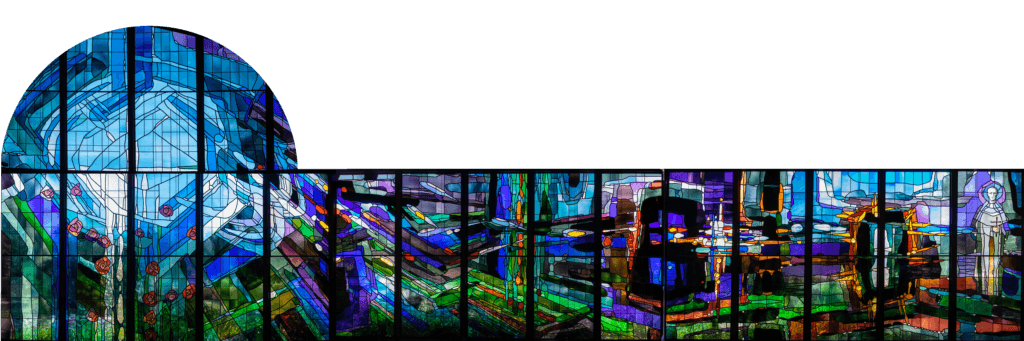
Fr. Citero: Well, hard act to follow. The only Carmelite thing I might add to it is the concept of Carmelite spirituality of the dark night. The obvious dark night analogy of that moment. Because sometimes people take advantage of a situation like that as an excuse, “Oh, there’s no God.” But when you, like Brother Lawrence, practice the presence of God and you’re in the middle of the dark night, that’s where the depth of spirituality really becomes somewhat overwhelming and beautiful. And I don’t know if you recall, but in our chapel here in Darien, there’s a stained glass window that kind of has Teresa Benedictus, Titus Brands, Carmelite Saints. And it’s a lot of different colors. And I don’t know if the remodeling affected this, but the artist created that the colors in that window went from panel to panel. And when you got to the corner where the building turned, you know, cornered, it was all dark colors. And the artist, that was the dark night. And when you went past that and kept following the windows, they got even brighter and brighter, the hope, you know, so that the windows at the top by the wood relief were all bright. You know, there was bright lights. And so that’s very Carmelite to move, but not to deny the darkness, not to deny the doubt or the fear, you know, or any of those things, but to move through them.
You know, and like any grief, you know, you don’t ever, you don’t get over it, but you get through it. You get through it, but you don’t get over it. And that kind of a loss, a lot was destroyed that day. Lives were destroyed, buildings were destroyed, but a lot of other things were destroyed in us as human beings. You know, our senses of security, our sense of what’s right, our sense of what of normalcy, you know, everything changed that day, you know, and we got through it. But we didn’t get over it. We still haven’t gotten over it. And we never will. But we got through it.
Ken Pino: It’s hard to see the good for the children and grandchildren of these people, but that their fathers and mothers and grandfathers and grandmothers who worked in those services did what they did in response to that day.
Fr. Citero: And that’s lived out in the number of sons and daughters who, of those people who died, particularly the first responders who died, many of their sons and daughters took up the battle, as it were, and became firefighters or police officers or Homeland Security or whatever they became to carry on that legacy.
Fr. Traudt: I think when you know someone that was killed there, it does make it very personal and it hurts like Sammy was pointing out. And I really struggled, to be honest with you, with forgiveness.
I remember the day after the attack, it was Matthew’s gospel all that week and it was the Beatitudes. And I thought, “Jesus is really appropriate, blessed are those who mourn and they’ll be comforted.” Then the next day, “Forgive your persecutors.” And I remember one priest saying to me, “I couldn’t read that at Mass.” He was afraid of what the people might say. I think he was also wrestling with his own feelings too. So that’s where it gets to be a struggle.
When you see these two magnificent structures and all the lives of people that were there, and they were innocent, they did absolutely nothing wrong except they were in the wrong place. There can be I do feel an anger over it, but it’s something that I can’t hold on to either. Eventually, it’s got to be put down. So it’s a challenge when 9-11 comes around.
Admittedly there’s been a long period of time since the attack took place, but there’ll be a lot of television in a couple of weeks, speeches given, sights seen again, and maybe even the attack itself. So it’s like an open wound that really never heals like you were pointing out, Sam. It never really heals, it’s always there. And you just struggle with it at times and bring it to God for healing.
Fr. Citero: Along those lines of the spirituality of all of this. Even though it’s hard from a human perspective to forgive, there’s an element to allowing our emotions to work for us. And I think that if, I think what caused that day to happen was hate. That was at the root, was hate. A hate that is grounded in an ideology I have no ability to grasp. Why people live their lives that way and have these feelings and have these thoughts and these compulsions to destroy people who don’t think the way they think, don’t believe the way they believe. It’s as simple as that. They hate us because of who we are. And there’s a good reason then to be very angry at them for hurting us the way they did. But I think that at the end of the day, if we hate them back, then they won. Then they say, “See, hate is the power. Hate is the power.”
And so as difficult as it is to forgive. I think that we do ourselves more harm by being hateful, vengeful, angry. All legitimate things that we should be and certainly were that day and are legitimate responses, but we have to get through them.
And to preach Christ crucified. And Christ crucified said, “Forgive them, Father, for they know not what they do.” The crucified Christ had a heart of forgiveness and of love and healing and reconciliation. And that’s why he won. That’s why love wins. Love always wins at the end. And while this seems cataclysmic for us in our day and our time, love wins.
Ken Pino: And I guess that goes back to what you’re talking about, John of the Cross and the stained glass. Accept that there is that dark night, but you can’t live in it. Live through it. Come out the other side. So maybe that’s the Carmelite spirituality piece. I think so. Yeah.
All right. I think that’s it, gentlemen. Thank you very much for sharing. I appreciate it. I know it’s not pleasant memories to walk back through.
Fr. Traudt: It’ll be here before you know it.
Ken Pino: Yeah.
Fr. Citero: It’s like the Kennedy thing. You know, like it’s 25 years ago. I find that hard to believe. Yeah. Because I could tell you it was yesterday that Joe knocked on the sacristy door and said, “Come up and watch this. There’s something happening.”
Ken Pino: I think that’s another difference. Like I said, here we had that fear that day, but I think we kind of moved. I don’t want to say moved beyond it, but we’re able to get through it a little bit faster than those of you that were so much more physically closer to it, physically and community-wise…
Fr. Citero: Yeah.
Ken Pino: …so close to it to kind of get through that.
The Carmelites of the Province of the Most Pure Heart of Mary, in allegiance to Jesus Christ, live in a prophetic and contemplative stance of prayer, common life, and service. Inspired by Elijah and Mary and informed by the Carmelite Rule, we give witness to an eight-hundred-year-old tradition of spiritual transformation in the United States, Canada, Peru, Mexico, and El Salvador, and Honduras.
Please consider supporting their mission
https://carmelitemedia.tiny.us/supportpcm
to make a financial donation.