
GO BACK!
Traveling the desert road toward purpose
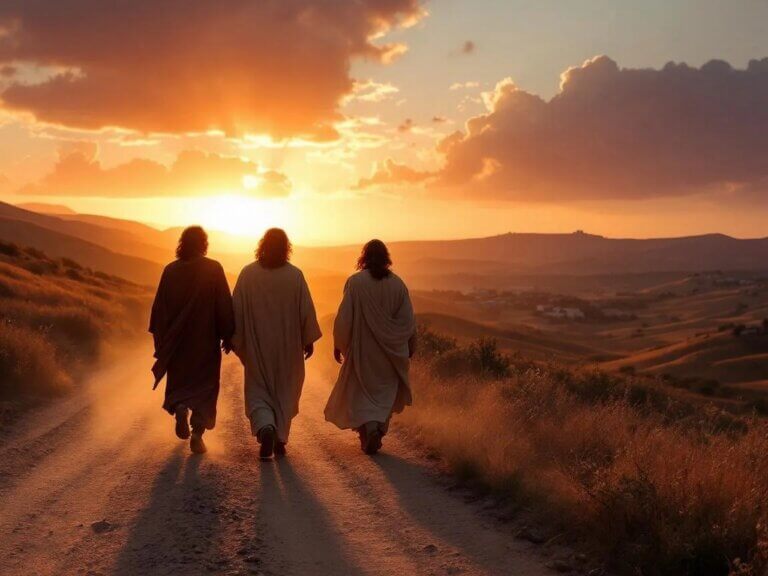
In “Go Back! Traveling the desert road toward purpose,” retreat guests at Into the Land of Carmel 2026, reflected on the paradoxical nature of spiritual progress. Drawing from Scripture, Carmelite history, art, and personal experience, the disciple’s journey is explored through the lens of the “desert road,” where in the twists and turns of life we often return to earlier places of encounter in order to move forward. The path toward purpose is explored through four stories that demonstrate the contradictions, contrasts, conflicts, and convictions that shape our Christian life.
Carmelite spirituality, and particularly the desert landscape of our rich tradition provides the framework for this exploration. The desert, with its stark beauty and sometimes treacherous welcome, symbolizes the tension between staying and going which marks the disciple’s search for God’s will. Whether one is a friar, sister, lay Carmelite, or simply a seeker, we find guidance through prayer, community, and service as the heart of the Carmelite charism. The invitation to “Go Back” is not regression but rediscovery, in triumphant return to the place where God first calls us, so that His voice may be heard anew.
In the first story, the Elijah mountain top experience does not come without risk, as the prophet faced the “contradictions” of seeking God where he thought God should be. Fleeing the aftermath of a spectacular victory, Elijah collapses under a broom tree and cries out, “Enough, LORD! Take my life, for I am no better than my ancestors.” Strengthened by a Messenger, he journeys to Mount Horeb, where God confronts him with the piercing question: “Why are you here?” Elijah struggles with the contradiction surrounding his current situation, after doing what he was called to do. He seeks God where he thinks God should be…the wind, earthquake, and fire, but encounters Him instead in “a light silent sound.” The encounter is profound, and God appears often in our lives, not in spectacle but in stillness. Elijah’s call to “Go Back” becomes a summons to renewed mission, humility, and trust as he still had more work to do.
A second story shifts the scene to the disciples on the Emmaus Road, interpreted through the artistic lens of the Baroque painter Caravaggio. Participants looked deeply into two depictions of the Emmaus Supper, where light is used to “contrast” the most important elements of the story from an otherwise lifeless canvas. The artist painted one interpretation in 1601, vibrant and full of abundance when fame and fortune were his reality; the other in 1606, subdued and shadowed by the artist’s exile and impending death sentence. In both paintings, Christ remains the center, yet the emotional tone differs dramatically. The artists use of light introduces us to how God might see our lives and situations through a divine gaze of mercy. Caravaggio’s use of light, sometimes bold, sometimes restrained, mirrors the disciples’ own experience of contrast in the Biblical account. They could not see the reality of the Risen Christ on the road, but were awakened at table, recognizing Him in the breaking of the bread. From this new place they find the courage to “Go Back” to Jerusalem with renewed zeal.
In yet a third story of traveling the desert road, participants understood the role that inner “conflict” has on the disciple’s journey. Conflict as an external and internal tension was a daily reality for the early Carmelite hermits, who settled near the Well of Elijah seeking solitude and prayer. When war forced them from the Holy Land, they were thrust back into European society, where their contemplative identity clashed with the active ministry demands of city life. This land was very different to them, because they were also very different spiritually. In Carmelite history, we see the conflict reach a tipping point in the famous “Flaming Arrow” letter of 1270, where internal tensions between those drawn to public ministry and those committed to solitude were revealed. These hermits faced a new reality, with new perspective as they learned quickly to “Go Back” to the spirit of the desert even when the physical desert was lost. Perspective becomes essential in the disciple’s journey, as a helpful tool for discerning through conflict and accepting that our prayers are not for changing God’s mind but for allowing God to change our hearts.
A final story highlighted the “conviction” of Kelley’s own personal conversion story. Once a financial professional, he found new purpose serving our neighbors experiencing homelessness. Relationships were formed which helped him understand the healing power of resilience, hope, and community. Leading a weekly discussion group deepened this transformation and led to a graced encounter with Jesus through the person of an elderly man named Jim. During a medical emergency with Jim, Kelley experienced a feeling of “lifting Jesus from the cross.” Later, from the back of an ambulance, this broken man, grasped Kelley’s hand and offered him a blessing, forging the entire encounter as a moment of grace. The encounter led to a radical course correction when he quit his job, embraced a call to ministry on the streets, and weathered many difficulties during the transition. It was a conviction to stay the course that taught humility, trust, and the courage to “Go Back” and help others over the next 20+ years have similar encounters with the Risen Christ.
Across all four stories, we find a common message: God often leads disciples through experiences where “forward is backward, up is down, and the only way is trust.” Elijah faced contradictions of where and how God appears in our life. The Emmaus disciples faced contrasting images of the Risen Lord. The early Carmelites grew through the inner conflict of their place and purpose. Finally, a moment of encounter led one man to a crisis of conviction as he was challenged to stay on the path. All lived in the tension of staying or going, ultimately discerning that God’s way is a direction in itself, because God is “Always, Already There,” as the late Fr. Jack Welch, O.Carm. often said. God journey’s with us on the desert road as disciples, and simply waiting for us to return to a place of encounter with Him. Here we find the strength to “Take courage…turn around, Go Back, find someone who needs us to be their strength in Christ,” on the desert road toward purpose.
Kelley Henderson, T.O.Carm. offered this reflection at a retreat talk at Into the Land of Carmel 2026 in Darien, IL. Kelley is a professed Third Order Carmelite, and serves as a member of the Inter-Provincial Lay Carmelite Commission (PCM and SEL Provinces), and as General Coordinator for the International Council of the Third Order of Carmel in Rome, Italy.

To learn more about the Carmelite Order and Charism, visit OUR SPIRITUALITY.
To learn more about the Carmelite Province of the Most Pure Heart of Mary, ABOUT US.
For any other information, please drop us a note via our CONTACT FORM.
The Carmelites of the Province of the Most Pure Heart of Mary, in allegiance to Jesus Christ, live in a prophetic and contemplative stance of prayer, common life, and service. Inspired by Elijah and Mary and informed by the Carmelite Rule, we give witness to an eight-hundred-year-old tradition of spiritual transformation in the United States, Canada, Peru, Mexico, and El Salvador, and Honduras.
Please consider supporting their mission
https://carmelitemedia.tiny.us/supportpcm
to make a financial donation.