
圣十字若望的祈祷之旅
“To those struggling on the path of meditation there are figures and forms and similitudes of faith; in the way of contemplation there is simply darkness, a presence in absence.”
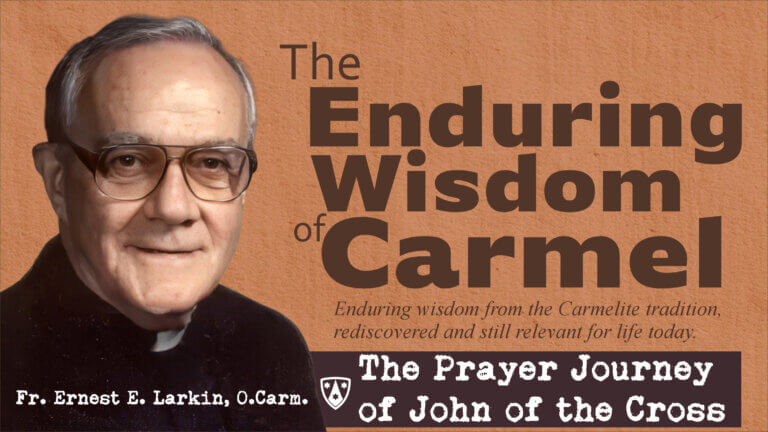
欧内斯特·拉金神父是一位美国加尔默罗会的神学家和教师。.
In one sense all John of the Cross’ teaching is on prayer, since the goal of his writing is divine union. But he has little on the mechanics or even the phenomenology of the act of praying. He moves on the higher ground of principles, and these he discusses around the three developmental phases of meditation, contemplation and union.
This paper is a schematic presentation of these stages in dyadic form: viz. meditation-mortification, contemplation-poverty of spirit, and union-in-symbols. The stages will be discussed in the framework of the first 15 stanzas of the poem, “The Spiritual Canticle”, as interpreted by St John of the Cross in his commentary, st.22, n.3.1 He assigns the first five stanzas to meditation-mortification, stanzas 6 to 12 (Canticle B) to the contemplative way, and the rest of the poem to union. The value of this study is to provide a road map of the sanjuanist journey to divine union.
The poem opens with immense pain of loss:
Where have You hidden,
Beloved, and left me moaning?
The bridegroom (Christ) has disappeared and left the bride (the soul) with a wound that only physical presence can heal. The first two stages of the journey have brought on the condition, because they have led the bride step by step into the void which John calls elsewhere “the deep caverns of feeling” (“Living Flame of Love”, 3). It is an intense experience of poverty of spirit that is frightening in its depth.
Everything has been lost for the sake of the Beloved, and the prize of union has not yet been given. Instead there is a bone-shattering hollowness along with a feverish yearning for God. The emotional element is real, because the whole person is caught up in an immense need that is frustrated. But the condition is more than emotional infatuation. It is metaphysical in dimension and fully spiritual, i.e. embracing every fiber of the bride’s being.2 Healing will take place when the crowning gift of union is received. Then the transformation of the soul into God will be complete; the spouses will be totally alike in perfect love and conformity of wills in a “union of likeness” (A 2.5.3; C 11.12; 12.7). The divine presence will not only be restored but bridegroom and bride, Christ and the person, will have a common life in “participant transformation” (A 2.5.7), with such a likeness that “one can say that each is the other and both are one”, (C 12.7), all the while retaining their own personal identities.
Overview of the Process
The transformation is the progressive assimilation of the image of Christ, first in the “outside” or normal functioning of the person’s life, where God is apprehended in metaphor and analogy, and then in the inner depths where God communicates himself in contemplation. Faith creates a sketch like a wax impression or sketch of a painting which is completed and perfected through growth in love (C 12.1). This pattern is like an archetype which is progressively enfleshed by putting off the false self with its illusions and desires and putting on a Christ-centered life (Eph 4:22-24). John makes it clear that the completion of the project is possible only through contemplation (C 11.12).
In the first stage of meditation and mortification, a phase John passes over quickly and by allusions without much extended treatment, the divine individuation is done by bits and pieces. Engaging images of Christ from the gospel replace the self-centered representations of ego and promote choices for God. The objective is to make Christ more attractive and desirable than other desires. The images thus increase the love, and it is love that fashions the likeness to Christ in the soul.
The transactions take place on the level of the sensible, which for John is ordinary thinking and willing. It is the level, of concrete images and the will-acts of affective or effective love that flow from these perceptions; it is the active dark night, of the senses. The passive night of the senses comes later and is the entrance into the spiritual way of contemplation, which is the author’s main concern in all his works. John is the great teacher of dark or apophatic contemplation, which is pure gift and almost identified with poverty of spirit. It is no accident that the keystone of the spiritual structure he builds in all his teaching is nakedness of spirit (A prol,9; see, also the emphatic development of this theme, in F 3.26-62), which is the outcome of the wholesale renunciation of all desires and the purification of the spirit effected by the dark night of the same name. This void and emptiness is a remote goal and beyond the scope of the stage of meditation-mortification, where the concern is the rectification and positive employment of sensible activity for the honor and glory of God. The famous nadas, which are the privation in will and affection of all sensible, and spiritual satisfactions, become the direct and proximate objective of spiritual striving at the end of the way of beginners, when contemplation is breaking into the person’s life. This state is still the night of sense in John’s usage, but on the horizon of contemplation. It has to do with our second dyad rather than the first.
The perspective is the biblical one of absolute and single love of God (Mk 12:29; see 10:18) against all other desires, but suited to the strength of the person (A 2.17.3) and pursued “with order and discretion” (A 1.13.7). These desires are indeed inordinate, precisely because they are not integrated into the love of God (A 3.16.2); they are thus competitors. The mortification of all such desires or appetites is the trademark of St John of the Cross and often a threatening challenge for would-be disciples. But for those who meditate, it is a long-term objective; for the time being they engage in the limited mortification of struggling to be more faithful to their vocation and the right use of creatures.3 The project of total renunciation is a reasonable objective when the soul is in the mode of contemplation.4
In that second stage, contemplation is the effective instrument of growth. The images which had served well in meditation are now broken open, and Christ is revealed in pure faith beyond the normal processes of thought, in imageless and wordless Mystery. Sanjuanist contemplation is the same one species of mystical grace which is defined as “nothing else than a secret and peaceful and loving inflow of God, which, if not hampered, fires the soul in a spirit of love” (N 1.10.6). It is divine wisdom, “loving, tranquil, solitary peaceful, mild” and it comes “without knowing from where nor how” (F 3.38; see also N 2.4.1; A 2.15.4). It is the source of “the paths and straits of love” (C 22.3). Contemplation is the purifying fire of the passive dark nights of both sense and spirit, and it comes from and leads to the pure faith, hope and charity that are the life of the spirit. There is a proliferation of terms in John of the Cross to describe this blessed state of contemplation-poverty of spirit, both in its positive context of the pure action of the theological virtues and its negative condition of nakedness and emptiness of spirit, spiritual poverty, selflessness, spiritual purity, annihilation of the natural mode and a number of other phrases (A 2.7.5; A 2.24.8; N 2.4.1; F 3.26-62 passim). The journey here is immensely simple: it is toward an ever-deeper affective detachment, which is at once the condition for and the consequence of sanjuanist contemplation.
Contemplation and poverty of spirit move the relationship with God to the level of the whole person and beyond particular goods and choices (A 2.4.4.). The total person is related to God in an authentic I-Thou, person-to-person relationship. The patch-quilt of meditation and mortification has given way to the seamless robe of contemplation. Particular representations of Christ that are the work of the imagination have done their task, so that now the fostering of the image of Christ is on the level of spirit and the result of contemplative love.
The goal of the whole journey, divine union, is described in the “Canticle” in the imagery of spiritual betrothal and marriage (C 22.3; F 3.24-25). This final self-communication of God makes the soul the perfect reflection of God, the mirror of the divine Beauty, Christ born anew and now fully formed in his spouse. The bride is transfigured; she has come home.
Inter-relationship of the Stages
These three stages are related to each other, not in linear, but circular fashion. The searcher moves in concentric circles that spiral inward toward the center that is Christ. The movements are not perfect circles, but more often ellipses, which may cross over from one stage to another. One’s place in the journey is determined by the predominance of a given stage. Thus there are mixtures of experiences in a person’s life, so that even experiences of union are possible in a beginner, and mature mystics can meditate, not only in prayer but in figuring things out making decisions and handling the business of life the way every one else does. The stages, in other words, do not exist in a pure state. They are valuable primarily as a way of organizing the understanding of spiritual development. Each dyad names the different tasks and points to
different moments in the process of Christogenesis.
The inter-weaving of the different experiences is illustrated in the fifteen verses of the “Canticle” under examination. There is no question, about the advanced mystical state of the bride, who is on the threshold of spiritual betrothal. But, to resolve the pain and anxiety of separation from God she proposes a vigorous asceticism (stanza 3) and a search in meditation for the Beloved (stanzas 4-5). These are roads already taken and now revisited.
We shall address these beginnings first and then describe the way of contemplation and of divine union. Even in our attempt to describe these passages there is an inevitable circularity, since the stages are best understood by comparison and contrast to each other. John’s commentaries seem to follow this same method of exposition (A prol. 8).
Meditation and Mortification
Meditation is the activity of the religious imagination that fashions “forms, figures and images” and deploys them in discursive activity (A 2.12.3). It is not a method of prayer as such, but a mode of intentional activity describing the ordinary thinking, feeling, deliberating, and choosing in active prayer and behind the variety of activities that make up the Christian life.5 The dynamics of meditation operate in every effort to live out the gospel, such as prayer, study, celebration of liturgy, work for justice, community building and ministry.6
Meditation involves images and concepts, affections and will-acts and moves discursively among these elements. It muses on images of Christ drawn from the gospel and life in order to come to know, appreciate and love him through these symbolizations of the Mystery. The process uses story and myth, visualization and sound, movement and fantasy to center on Christ and to muster strength for the mortification demanded for growth in the love relationship. Many-minded and undisciplined, the self-centered beginner addresses the task of building up a new self-identity by replacing the images that control her life and reordering her choices and desires accordingly. This double-pronged effort of meditation and mortification cultivates satisfaction and pleasure in God and the strength to deny gratification in objects not related to him; it gives primary attention to habitual sins and imperfections (A 1.11.3-5).
The meditation is the first step in the metanoia process. One needs to change one’s thinking, if one’s loving is to move from conflicting desires to the single love of Jesus Christ. John sets down this primary text in the Ascent:
First, have a habitual desire to imitate Christ
in all your deeds by bringing your life into
conformity with his. You must then study his life
in order to know how to imitate him and behave
in all events as he would. (A 1.13.3)
This work of the religious imagination will change the interpretive schemes and educate the desires of a person’s life. These building blocks of a new consciousness include every particular, thematic, psycho-social expression of the person’s relationship with God in thought, word, or even deeds. So images are one’s inner world of insights, feelings, judgements, stories, myths, ideas and values, choices and commitments.
The process of meditation is the weaving of a new tapestry of one’s life by connecting outside experiences with the presence of Christ within.7 Verses 4 and 5 of the poem illustrate the process:
O woods and thickets,
Planted by the band of the Beloved…
Tell me, has He passed by you?
Pouring out a thousand graces
He passed these groves in haste;
And having looked at them,
With His image alone
Clothed them with beauty.
The beauties of nature reveal God, but only partially, from afar, and not in person. Created representations are mere signs pointing to an absent Presence. One day in divine union these forms will be trans-formed, the figures trans-figured, because the mystic possesses the God who is at the core of their being; then they will be symbols containing and evoking that, Presence, and the bride will say:
My Beloved is the mountains,
And lonely wooded valleys… (stanza 14)
The change is not outside in nature but in the transformation of the mystic. The state is the anticipation of glory, “the revelation of the sons of God,” when creation will finally share “in the glorious freedom of the sons of God” (Rom 8:19,2). This state of divine union is the goal: meditation and mortification are the humble beginnings of the Journey to that goal. Faithfully pursued they will wean the soul away from worldly interests and bring about “a more intense enkindling of another, better love (love of one’s heavenly bridegroom)” (A 1.14.2); this is the foundation for the gift of contemplation, and it invites the person to the full implementation of chapter 13 of the Ascent (Book 1) and to the subsequent purification, of Books 2 and 3 (see A 2.1.2; 2.4.2; 2.7.2; 2.11.9).
These beginnings of the second dyad are the divine invitation to live on the level of spirit, which God gives “after beginners have exercised themselves for a time in the way of virtue and have persevered in meditation and prayer.” For it is through the delight and satisfaction they experience in prayer “that they I have become detached from worldly things and have gained some spiritual strength in God. This strength has helped them somewhat to restrain their appetites for creatures and … suffer a little oppression and dryness without turning back.” They I have done the preliminary work and are ready to enter the night of a pure faith walk without any immediate satisfactions. In exchange for “sensible consolations,” which include all self-validating experiences, even aridities borne with a sense of accomplishment, God now “leaves them in such confusion and vulnerability that they do know which way to turn in their discursive imaginings; they cannot advance a step in meditation, as they used to, now that the interior sensory faculties are engulfed in the night. He leaves them in such dryness that they not only fail to receive satisfaction and pleasure from their spiritual exercises and works, as they formerly did, but also find these exercises distasteful and bitter” (N 1.8.3.). Contemplation is a new way of relating to Christ. It lifts up the whole person in faith and love from the inside out. But until it is firmly in place, and that is to say until the sensible order of things has been fully integrated into this thrust, until the night of sense has been traversed, and the person is able to dwell peacefully in the quiet nothing of contemplation, these first graces of contemplation will be a painful journey in darkness, validated only by the three signs the Saint lays down (N 1.9; A 2.13). Between this entrance, which is the passive dark night of sense, and the exit, which is the passive dark night of spirit, and including both these doors, lies the proficient’s way of contemplation.
The Way of Contemplation
For John of the Cross meditation is a remote means, contemplation a proximate one to union with God. Meditation brings the Christ down to human proportions; it delivers the Lord, but, in the images of the finite. John compares it to the husk, or rind that enclose and bring forth morsels of spiritual communication or nourishment (A 2.14.2; 2.16.3; 2.17.5 & 9). The little kernels of faith, hope and charity are morsels of true spirituality which eventually coalesce and allow the relationship with Christ to rest on a deeper level. The habit of contemplation is formed, and this way of “habitual and substantial, general and loving knowledge,” becomes a way of life (A 2.14.2). Visions and revelations and other particular supernatural communications are in the same imperfect category of images as meditation; they too are “the wrappings of spiritual communication” (A 2.16.11; 2.11.5-6). In this analysis, even when they are authentically supernatural, their only value lies in the interior spiritual regeneration which caused them in the first place (A 2.17.7).
In John’s anthropology the processes of meditation-mortification are rooted in embodied, sense life, the level of ordinary “natural” operations. Grace is essential there, but working in a human mode. The region of contemplation is the spirit, the level of obediential potency where God gives himself in pure faith, hope and charity. This mature theologal life transcends images and breathes the free air of total disponibility to the divine intervention. The active effort in the night of the spirit is to live a faith life in utter purity of heart without the distraction of selfish interest, immediate pay-off, without any human support systems, even structures of meaning and the security of tested experiences that give one reassurance and personal direction. To be thus totally in the hands of God is a frightening and threatening prospect. It is a call to walk in unlimited transcendence, moving beyond anything and everything that is not God. It is the way of the nadas of the Mount of Perfection.8 This is spirituality in its pure state a delivery system of knowledge and love that does not depend on the visible and tangible. Word and sacrament and the created order in general remain in place and as the instruments of mediation between God and the human being. The way of contemplation does not remove one from the human condition either in church or world. But the life that comes through these forms and strictures is not compromised by their finitude limited to little morsels because of the finite conduit. The creaturely condition is engaged and yet transcended in these operations, and there is presence to the living God. It is beyond the scope of this paper to enter into theological explanations of the experience. In John’s mind the theological virtues acting without encumbrance or distortion from an unredeemed psyche or spirit offer a sufficient explanation for the “inflow of God” (A 2.15.4; F 3.38). Contemplative living is a life of contact and presence to the hidden Christ that allows the unlimited variety of human expressions that loving faith can embody. It is unalloyed faith and love, whatever the human dress.
The love of Christ that thrives in meditation’s forms is limited by the sensory quality of that approach. The understanding is partial and superficial and does not remove all the distortions of ego or the unrecognized motivation of the unconscious. Images in other words image God poorly and for this reason John calls for their “denuding”:
Like a blind man [the contemplative] must
lean on dark faith, accept it for his guide and
light, and rest on nothing of what be
understands, tastes, feels, or imagines. All these
perceptions are a darkness that will lead him
astray. Faith lies beyond all this understanding,
taste, feeling and imagining (A 2.4.2).
The chapters on beginners’ faults (N 1.2-7), which describe the capital sins gone underground and appearing in spiritual disguises, are the flawed outcome of the self-direction of meditation.
Contemplation can deal with these dead ends, because it moves beyond objects. Thus the call to “renounce and remain empty of any sensory satisfaction that is not purely for the honor and glory of God” (A 1.13.4) is fully logical in a contemplative perspective. The totality of person-to-person relationship with God is the single concern not pieces of
knowledge or isolated satisfactions. The relationship, hence contemplation, is greater than any partial expression or all of them put together.
So the bride in the “Canticle” wants no more images, no more “messengers”, since “they cannot tell me what I must hear” (Stanza 6). She has moved beyond words to the Word, and the communication now is ineffable:
All who are free
Tell me a thousand graceful things of You;
All wound me more
And leave me dying
Of, ah, I-don’t-know-what behind their
stammering.
The “I-don’t-know-what” is the grace of contemplation. It is camouflaged at first, too delicate and too new and different to be recognized for what it is. Even when the contemplation becomes the customary way of prayer in the quiet, peaceful plateau between the two nights, it remains an ineffable “I-don’t-know-what.”
Both the stanzas and the commentary illustrate the fact that the way of contemplation in no way removes one from the involvements and transactions of life. In the present stanza it is experienced in the exchanges of friends. Contemplation is a hidden state of being before it is any particular mode of consciousness. It is a depth relationship with self, God, and the world that has innumerable phenomenological expressions. Its surest sign is a quality of all-pervasive love. Because the knowledge is by way of love, it lacks the clarity of this or that image or concept. So it is dark and obscure, favorite words of St John of the Cross. The darkness is not always painful; in itself the darkness is friendly because it is the loving God communicated. It is soon experienced as the “tranquil” (stanza 15) and “serene” (stanza 39) dark night beyond the time of purification. The darkness wounds only to heal, and it heals by bringing the whole person into union with God.
In contemplation one enters the holy of holies beyond mere representations and figures, beyond any identifiable mystical phenomena such as visions and locutions, ecstasies or miracles, beyond any of the old landmarks or consoling understandings or reassuring oases. There is no new technical knowledge. The knowledge and skills that provided self-direction remain in place, and the living “unknowing” of contemplation provides only a sense of God and a spiritual affinity and con-naturality in the things of God. Nothing is changed, yet everything is changed, because of the deeper and more wholistic, and more loving quality of life.
This love grows to enormous proportions and in the absence of felt presence of the Beloved there is profound frustration and impatience, the disorientation “of not living where you live” (stanza, 8). The purification consists precisely in the patient endurance of this state. But it costs, and the lament of the bride gets more and more intense. She desperately wishes to be with him, but for this she must wait. Meanwhile life must go on, and this is an added burden: “such souls suffer much in dealing with people and with business matters.” Their hearts are elsewhere (C 10.2; 11.10).
The “arrows” of love (stanza 8) continue their task of configuring the person to Christ. The Word of God, the Christ who is spirit, becomes more and more the totality of the person’s life. The Mystery of Christ now relativizes everything and is experienced as the all-inclusive meaning of reality (A 2.22.5). The surest sign that growth is happening is the falling away of all creature supports, sensible and spiritual, in imitation of Christ in his passion and death (A, 2.7). This death-like experience is complemented by the awesome thrust toward union with Christ. Its healing lies in the transformation desired; the bride begs to be carried off like stolen booty (stanza 9). The response is the betrothal and marriage in which the spouses become one.
Divine Union
The desire for the real presence of the Beloved is put in the metaphor of vision, so that the eyes carry the message of yearning from stanza 10 to the ecstasy of stanza 13. The bride begs to see the Beloved:
…may my eyes behold You,
Because You are their light,
And I would open them to You alone.
This is a desire for face-to-face vision (C 10.7), a vision which only the passage through death allows. She willingly accepts this condition, even prays for it in stanza 11: “And may the vision of Your beauty be my death.” In the beatific vision “presence and image” are complete, because then at last “the lovers are so alike that one is transfigured in the other” (C 11.12). This is the ultimate state of assimilation to Christ, the perfection of the original sketch or image of Christ, Bridegroom, Word, and Son of God (C 11.12). The earthly state of divine union turns out to be something short of this beatific vision.
Yet there is incredible identification of the spouses, and the image of eyes brings this out. In stanza 12 the bride wants to peer into her lover’s eyes. So she looks into her faith that reveals the Christ, into an image become-symbol that contains and evokes the reality of Christ. The faith is the beautiful cristalina fluente, the crystal-clear Christ-fountain, which Kavanaugh translates as “spring-like crystal.” She wants her eyes to meet the eyes of Christ present in that symbol, on the outside surface of faith, which are its propositions and dogmas. What does she see? His eyes indeed, but eyes already part of her very being, “sketched deep within [her] heart.” Now the enfleshment of the Beloved in herself is complete, because the spouses share the same faculties in incredible co-inherence. The experience is too much to bear and she flies off in ecstasy.
The detail of the eyes is almost surrealistic. Divine union is usually described in terms of the divinization of the faculties of intellect and will (e.g., F 2:34) or participation in the divine attributes ( e.g., F 3:2-17). Here the homely figure of the eyes is the sign of the transformation. His eyes are her eyes, since they are engraved in her being, and her eyes his, because the mystic “lives no longer herself, but Christ lives in her” (Gal 20:20; C 12.8).
To those struggling on the path of meditation there are figures and forms and similitudes of faith; in the way of contemplation there is simply darkness, a presence in absence. Now the faith is brought to perfection in symbol. The mystic apprehends her Beloved in his truth and reality, still in faith, still in the “silvered-over outside” of the propositions and articles of faith, but with an immediacy of love that penetrates to the inner reality of those truths. The outside truths are now symbols.
In the ensuing dialogue the depth of the Realism of the mutual indwelling is underlined. “Withdraw your eyes,” the bride calls out: she cannot sustain his gaze. Note that now he is the one who is gazing on her with love and she cannot bear it; the eyes are his, but mirrored in her own being and now experienced. He calls her back from the threatened flight of the spirit and utters the astounding revelation that he too has been suffering the wound of love and has been healed by her very flight. Once again the roles are exchanged. Until the transformation she was the wounded dove and he was the stag who wounded her. Now in the two becoming one the wound is transferred to him and he is healed, “cooled by the breeze of flight” (stanza 13).
From this point on in the poem all creation becomes the symbol of the Beloved, just as the Christ-fountain of faith reveal the very eyes of Christ. Stanzas 14 and 15 are a magnificent symphony in which bride and bridegroom and all of creation are made one together. Enraptured in the beauty of her Beloved in her own being the bride celebrates that same beauty in the beautiful and wonderful things of creation. The inner experience is the outer experience; inner transformation and outer sacrament are perfectly coordinated. So the experience of her Beloved is her experience of mountains and valleys, islands and rivers, breezes and dawn, as well as the oxymoron of “silent music” and “sounding solitude.” Her Beloved is everything to her, and everything is her Beloved, not in a pantheistic sense, but as symbols revealing and concealing, the inner Presence. In a final personalistic reference at the end of the list of symbols in stanza 15 the Beloved is “the supper that refreshes and deepens love.” The Eucharist perfectly exemplifies the profound identity of human and divine experience. For the mystic in divine union every supper is eucharist, the experience of the real Presence in symbol.
The end of the journey has been reached. The human subject has become “God by participation,” so that there is utter transparency in her own embodied being and in all of creation. No longer are their forms and figure separated from their origin and final end. Their truth and reality are manifest now as a bonus of detachment (A 3.20.2). The forms and figures which were the stepping stones to God in the-first phase and which were abandoned in favor of dark faith in the second phase are now repossessed in a transformation and a trans-figuration that bring them into the one divine symphony and the spouse can sing with St John of the Cross:
Mine are the heavens and mine the earth.
Mine are the nations, the just are mine, and mine
the sinners. The angels are mine, and the Mother
of God, and all things are mine; and God Himself is mine
and for me, because Christ is mine
and all for me (“Sayings of Light and Love”, 25).
1 The commentaries of St John of the Cross are referred to as follows: A = The Ascent of Mount Carmel; N = The Dark Nigbt; C = The Spiritual Canticle; F = The Living Flame of Love. All references are to The Collected Works of St John of the Cross (tr. Kieran Kavanaugh, OCD and Otilio Rodriguez, OCD, Washington, D.C.: Institute of Carmelite Studies, 1979).
2 Thomas Tyrrell in his Urgent Longings (Whitsunville, MA: House of Affirmation, 1981) rightly identifies the “urgent longings” of the poem “Dark Night” as the imperfect love of infatuation and he develops the cure, which is contemplative love. A similar condition obtains in the opening stanzas of the present poem. But it can hardly be called infatuation. It certainly is not the shallow romantic enthusiasm of an inexperienced beginner who has not yet experienced contemplation (e.g., N 1.1.3). The yearning for God here comes out of a profound degree of purity of heart and looks for transforming union. This depth experience at the threshold of the ultimate union which John identifies as a union in the substance of the soul involves the total being of the person.
3 Ernest E. Larkin, O.Carm., “The Role of Creatures in the Spiritual Life”, in Proceedings of the Catholic Theological Society of America 17 (1962) 207-234, esp. 216-223.
4 The distinction drawn between the limited mortification of the first dyad and the pursuit of the total renouncement connected with contemplation may seem uncharacteristic of St John of the Cross’ perspectives. But that is a wrong perception. Abnegation and the love of God are always in tandem in his writings; total detachment is the underside of perfect love. The fervent seeker does not set limits in ideals, only in the application of the absolute demands of the gospel. The distinction suggested seems helpful for pastoral reasons; it is clearly implied in passages like N 1.8.3 which will be examined later, and explicit in A 3.39.1.
5 This interpretation of the meaning of meditation in John of the Cross fits the role of the religious imagination as described in contemporary literature. The imagination is not a single faculty, but ordinary consciousness. In the words of one of its best proponents, William Lynch, S.J., it is “all the resources of man [sic], all his faculties, his whole history, his whole life, and his whole heritage brought to bear on the concrete world inside and outside himself, to form images of the world, and thus to find it, cope with it, shape it, even make it… The religious imagination… tries literally to imagine things with God”. Christ and Prometheus (Notre Dame, 1970) 23, cited by Michael Gallagher, “Imagination and Faith”, in The Way 24 (April, 1984) 120-121. The whole issue is on the topic of the imagination, as is the February, 1985 number of Studies in Formative Spirituality and a recent issue of the Irish Theological Quarterly, 52(1986) 1/2.
6 Cultivating the love of God has many faces and all of them contribute to the formation of Christ within. St Teresa of Avila puts the matter practically. “if contemplating, practicing mental and vocal prayer, taking care of the sick, helping with household chores, and working with the lowliest tasks are all ways of serving the Guest who comes to be with us and eat and recreate, what difference does it make whether we serve in the one way or the other?” The Way of Perfection 17.6, in The Collected Works of St Teresa of Avila, 2, tr. Kieran Kavanaugh, OCD, and Otilio Rodriguez, OCD, Washington, D.C.: Institute of Carmelite Studies, 1980).
7 An interfacing of this concept of the role of meditation with the intensive journal theory of Ira Progoff that proves to be helpful in understanding the relationship between meditation and contemplation is developed by John McMurry; S.S, “Spirituality for a Secular Culture: a Cbristological Interpretation of Progoff’s Intensive-Journal Method” in Review for Religous 47, (1988) 383-392.
8 The original pencil sketch of “Mount Carmel” in notarized copy is found in Kavanaugh, Collected Works, 66-67.
如需进一步了解加尔默罗会的历史、神学和灵修,请访问“加尔默罗会文库”(Carmelitana Collection)网站: carmelitanacollection.org
关于拉金神父:
拉金神父(Ernest E. Larkin)于1922年8月19日出生于芝加哥。他作为高中神学生进入安大略省尼亚加拉瀑布市的卡梅尔山学院就读,并于1939年6月毕业。 他于1940年宣发圣愿,并于1943年从卡梅尔山学院毕业,获得哲学学士学位。1946年6月8日,他被祝圣为神父。 拉金神父于1947年6月在怀特弗里尔斯完成了神学学习,并在夏季期间于天主教大学攻读了英国文学的研究生课程。 他在罗马的“天使大学”(圣托马斯大学)完成了神学研究生课程,并于1954年获授神学博士学位(STD)。 拉金神父被派往该修会的大修院——怀特弗里尔斯,1951年至1959年间,他先后担任教师、灵修指导师,最终出任学生事务主任。 1959年,拉金被任命为美国天主教大学苦修与神秘神学讲师,随后担任助理教授,继而晋升为副教授,直至1971年辞职。 在此期间,他还曾在圣母大学圣玛丽学院为初学导师开设硕士课程,并在美国天主教神学学会上发表了他的第一篇论文。 《受造物在灵修生活中的作用》(1962年)。他还担任《新天主教百科全书》苦修与神秘学领域的顾问编辑,该书刊载了他的多篇文章。 在天主教大学任职期间,拉金曾在伊利诺伊州蒙德莱恩举行的男子修会主要会长会议上发表演讲,并在美国教会法学会的多次会议以及修女培育会议上发表演讲。 他在所属的加尔默罗会团体中十分活跃,1966年至1972年担任省会理事会成员,特别负责灵修生活领域的工作。他于1965年、1968年、1971年和1983年当选为罗马总章会议代表。 由于健康原因,他于1970年2月被迫从大学请病假。随后,拉金神父受邀担任亚利桑那州凤凰城新成立教区的驻教区神学家;在1970-1971学年休假结束后,他辞去了天主教大学的职务。 1972年,拉金神父共同创办了基诺学院(Kino Institute),该学院最初名为“凤凰城教区神职人员、修会会士及平信徒成人宗教教育学院”。他担任首任院长,并协助制定了该学院的目标与宗旨。两年内,学生人数增长至1780人。.
20世纪70年代,拉金在美国各地以及海外(包括远东地区)举办了许多静修会和研讨会。 他曾在圣路易斯大学(1978年)和奥马哈的克雷顿大学(1979年)担任暑期学校讲师,并担任菲尼克斯教区主教与天主教神恩运动之间的联络人。.
在此期间,拉金发表了多篇论文,并应主教会议委托,于1973年出版了开创性的著作《美国神职人员的灵性更新》。拉金担任该书的联合编辑,并撰写了最终定稿。 20世纪80年代,拉金神父的牧灵工作包括在圣母大学为“国际静修会”和’神职人员继续教育项目“开展更新计划,以及为罗马加尔默罗会士提供持续培育课程。 他曾担任国际评论刊物《Concilium》灵修专栏的顾问,以及华盛顿特区”人类发展中心“的顾问。这几年间,拉金神父还出版了两部著作: 《静默的临在》(1981年出版,2001年修订增补),该书探讨了分辨作为一种过程和问题的内涵;以及《我们内心的基督》(1984年),这是一部散文集,探讨了当代人对基督、教会与自我的体验。.
1982年,拉金成为“加尔默罗会论坛”的创始成员,该论坛由来自两个修会传统的学者组成,致力于研究和推广加尔默罗会灵修。该论坛在圣母大学圣玛丽学院举办的年度研讨会,吸引了来自全国各地的神职人员和教友。 拉金的主讲内容不仅发表在期刊和研讨会文集中,还以录音带形式发行。 (ICS出版)2000年6月在圣母大学圣玛丽学院举办的“加尔默罗会论坛”。保利斯特出版社将该论坛的其他论文与拉金的神学论述一并收录于《加尔默罗会的祈祷》一书中,该书是为纪念加尔默罗会灵修研究先驱厄尼神父而编纂的纪念文集。.
他的论文《禧年灵修》荣获天主教新闻协会颁发的“2000年度灵修类文章”一等奖。“
拉金神父一直从事教学、举办静修会、参加研讨会和写作,直到2006年去世。.
圣母纯心会加尔默罗派教徒效忠耶稣基督,以先知和沉思的姿态祈祷、共同生活和服务。 在以利亚和玛丽的启发下,在加尔默罗会规的指引下,我们在美国、加拿大、秘鲁、墨西哥、萨尔瓦多和洪都拉斯见证了长达八百年的精神转变传统。
请考虑支持他们的使命
https://carmelitemedia.tiny.us/supportpcm
捐款。