
Praying with Brother Lawrence of the Recurrection
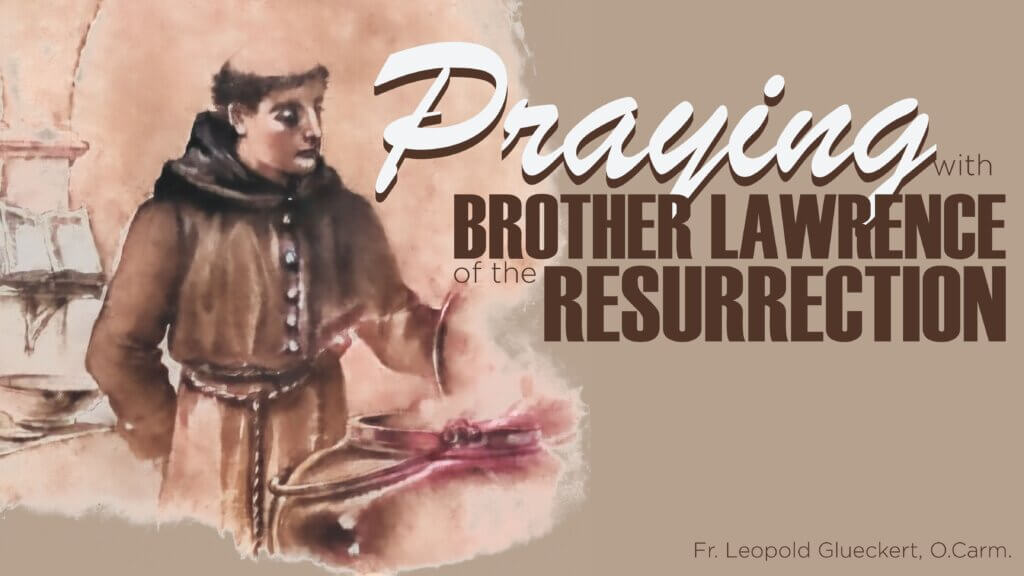
While many experts and teachers of prayer and devotion are often gentle men and women with a decent education and a flair for good writing, Brother Lawrence is an odd variant on that pattern. A rough-cut commoner who worked with his hands, he walked a simple path alongside his loving God. He serves as a vivid reminder that even the “little guy” is not an alien in God’s mansions. Through his writings, Lawrence continues to teach and inspire countless readers with his good sense and simple encouragement.
Although he died three centuries ago, Brother Lawrence seems to be surprisingly at home in any age, including our own. Because of the seemingly endless wars in our time, most of us have seen soldiers return from battle with their bodies intact, but their souls virtually destroyed. What we call PTSD is finally receiving attention from medical and psychological researchers. The traumatic horrors of what these men and women have seen and done in war continue to disturb their sense of balance and well-being. Traditional values of right and wrong sometimes don’t seem to apply any more. Our faith in the essential fairness of God and the universe gets blown to smithereens, and a permanent sense of discouragement and pessimism takes control of even our most cherished activities. Lawrence lived in that gloomy realm.
But in some rare cases, these disturbing events can become a blessing in disguise, as individuals struggle to cope with their own tragedy and suffering, and that of others. His odyssey begins when he was Nicholas Herman, a young soldier from the Duchy of Lorraine. In the 17th century, Lorraine was not yet a part of France, but an independent state of the Holy Roman Empire, where people spoke either German and French, or a jumble of both. He was born about 1614, and raised near Lunéville, a medium-sized market town in what is now the easternmost part of France. We know that his parents were respected people who raised him to be a religiously inclined young man, and that he could read and write. But that’s about all. We would certainly like to know more about about his personal background and education, but the information is simply not there.
As fortune would have it, young Nicholas grew up during the calamitous Thirty Years War, which devastated all of central Europe between 1618 and 1648. This dramatic clash is sometimes passed off as a simple conflict between Catholics and Protestants in Germany, but it was far more complex than that. There were actually about fifteen separate conflicts with distinct political, economic, and social causes, which started and stopped during the same period, and then sometimes burst into flame all over again. But each separate war managed to influence and aggravate many of the others, and each seemed to carry its own toxic blend of religious hatred and intolerance, to say nothing of horrid atrocities. It was certainly not a good time for gentle idealists.
Since war pervaded all of Europe, it may have seemed that fighting for some ambitious prince or religious faction was a fairly “normal” existence. Possibly at the age of 20 or so, Nicholas enlisted in the Duke of Lorraine’s army. He may have done so out of religious zeal as a loyal Catholic, or simply because poverty left him few other opportunities. It was a horrid experience. The chaotic nature of 17th century warfare was something that affected his mind deeply. At that time, there were a few units of disciplined, professional soldiers, but most military contingents of the age were simply bands of heavily armed thugs who were not paid, but were expected to support themselves at the expense of the civilian population.
Bitter hatred between Lutheran, Calvinist, and Catholic factions during this period was further complicated by the shifting alliances of private armies and small mercenary units who made and unmade coalitions among themselves for the most dissolute motives. Soldiers’ primary loyalty was to their commanders, rather than any religious or regional ideals. And those commanders generally saw their purpose as getting rich at the expense of everyone else, regardless of what means they used. It was all but expected that marauding armies would plunder villages, murder civilians, and shoot or dismember their prisoners. Since the officers had no interest in disciplining their troops, the path of any army usually left devastation, with pitiful cripples and beggars in its wake. Even two centuries later, vast areas of Germany had not recovered from the War’s desolation.
At the time when Nicholas served, there were 6 distinct armies fighting in Lorraine, battling civilians and one another. In 1635, he fought with the Lorraine militia against Swedish infantry and French cavalry at Rambervillers, not far from his home village. (Rambervillers had 2660 inhabitants at the time – 8 years later there were only 400 survivors.) He received a serious wound which caused him to limp for the rest of his life. He was later captured by German Protestant soldiers who accused him of spying, and threatened to hang him. But then they released him because his manner was so nonviolent. Because of his serious injury, he was discharged from his regiment as no longer fit to fight. Once again he was a civilian, and very much on his own. He had survived the war, but his chance of returning to a “normal” life was virtually destroyed.
The ghastly experience of battle seared his mind to such a degree that the specters of those atrocities never left him. We have no way of knowing if Nicholas had killed others, or had just seen killing, looting, and pillage. He never spoke of the horrors he had experienced, but the effects remained with him for the rest of his life. One thing which also remained with him after his military career was the need to turn away from the violent conduct of his past. He remained obsessed with his quest for redemption. He had experienced too much horror to ever be free again.
He drifted through civilian life for several years without any real success. He saw a life with God as his refuge and attempted to become a hermit, but with no proper direction or mentorship. Being an authentic hermit is not a prospect for beginners, and this endeavor failed miserably. Then he attempted to serve as a footman to William de Fieubet, treasurer to the King of France. But he was so clumsy, so awkward, that he “broke everything” as he later recounted. There was no future for him as a gentleman’s servant either.
It seemed that the only positive thing that he was able to cling to in his life was a religious conversion event. He remembered that at age 18, he had experienced a powerful insight when he saw a stark, ghostly tree stripped of its leaves and all signs of life during a particularly severe winter. And yet he knew through the eyes of faith that in the early spring, God would restore life to that tree, with a profusion of leaves and fruit. Buoyed by this shred of hope, he decided to take a bold step toward restoring spiritual health to his own devastated life.
So finally, in 1640, he went to Paris, where he asked for admission to the Discalced Carmelites as a working brother. His uncle, Jean Majeur, had also been a Carmelite brother and a significant spiritual influence in his life. His uncle helped him to see the dangers of the secular world, which would never allow him to leave his past behind. Nicholas was 26 years old, still awkward, and lacking in most practical skills. He fully expected to do badly in the monastery and to be ridiculed. But he was welcomed and accepted by the other friars, treated kindly, and fit well into the community. He later addressed God in an upbeat mood, “You tricked me!” In those days, religious brothers were the practical work force for the monastery, doing manual labor, begging for alms, and praying as they worked. Herman remained there for the next 50 years with the religious name of Brother Lawrence of the Resurrection. For much of that period, he worked as a cook for a community of nearly 100 friars, and later also served as a sandal maker and a wine buyer.
His first 10 years in the monastery were a time of difficult inner struggle, when he still felt he had no hope of salvation. He had a private nook near his pantry where he would go to pray in desperation, as if he had nothing left except his stubborn trust that God would not allow him to be lost. He had a small picture of Jesus tied to the pillar, covered with wounds. It served to remind him that he was not the only one who had suffered. But this desperation led him to a point of resignation to the mercy of God, which helped him find peace. He was afraid of self-deception, so he simply placed all his trust in God without any conditions.
The hope Lawrence had learned from the resilience of the barren tree stayed with him as he purged the lingering wartime demons. If life could flood back into that dead trunk, then maybe God’s love and forgiveness could restore love and courage to him as well. He decided to reject the love of anything which was not God, and thus grew in the active recognition of God’s presence in every detail of his life. He discovered that he was able to pray at all times, even if it was no more dramatic than just repeating the Lord’s Prayer. Even in distractions, God’s help was there.
“I have very often experienced the ready help of divine grace upon all occasions. When I have business to do, I do not [worry] about it beforehand. When the time comes to do it, I see in God, as clearly as in a mirror, all that is needed for me to do.”
It surprised him that even when he was peeling potatoes, seasoning soup, or scrubbing kettles, he was able to make his tasks an integral part of his prayer, the actual vehicle of the process. Using his “methodless method,” he was able to carry on a running exchange with the loving God of the universe. His anxiety and fear gradually turned to gentleness toward everyone. Instead of apprehension, he began to radiate gratitude and quiet joy.
He was later able to say:
“The time of business does not differ with me from the time of prayer; and in the noise and clatter of my kitchen, while several persons are at the same time calling for different things, I possess God in as great a tranquility as if I were upon my knees at the blessed sacrament.”
He had plenty of spiritual stimulation to help him formulate his prayers. Lawrence had joined a community of other men who were also dedicated to silence, solitude, and reflective prayer. Other friars in his community helped with devout conversations, spiritual reading in the refectory, and good preaching in the chapel. There was the regular rhythm of liturgical prayer every day, as well as a continuous stream of teaching from the Holy Scriptures and the classic writings of Carmelite authors. There were many outsiders who came to visit the community or worship in the Carmelite church. Conversations with accomplished professors or humble seekers raised questions and formulated answers about God’s walk with the individual. He learned eagerly from all of it.
Once he had come through the turmoil of those first ten years, Brother Lawrence was able to help others to be comfortable with their own prayer in the most ordinary circumstances. In his contact with beggars and working people, he encouraged them in simple conversations with God. His kitchen became a sort of “chapel” where cart drivers, grocers, or fishmongers could hear practical advice on how God cared for their concerns. He was fond of telling people that God had so much “treasure” to share with each of them, but that we so often tend to be satisfied with small bits of private devotion that block us from going further.
His personal prayer life developed by simply being aware of the presence of God in his kitchen, and carrying on a loving conversation with one who loved him dearly. In the early years, he had been obsessed with his sinfulness. He thought a lot about death, judgement, heaven and hell. But then he gave up all the devotions, helps, and props that were not strictly required. He fell back on the simple awareness of God’s presence under all circumstances. Speaking was not required. If he lost the awareness for a moment, he tried to get it back without delay. After a while, his work and other activities were no longer distractions, but springboards to more creative conversation with the Lord.
On one occasion, he wrote:
“I flip my little omelette in the frying pan for the love of God, and when it’s done, if I have nothing to do, I prostrate myself on the floor and adore my God who gave me the grace to do it. After that I get up happier than a king! When I can do nothing else, it is enough for me to pick up straw from the ground for the love of God.”
Lawrence took the prayer of recollection and made it attractive to anyone. He was blessed with a clear and no-nonsense way of speaking, and gave lucid advice to help others follow his process. Countless people of every social class learned to begin, continue, and end every action by lifting themselves to God. He actually wrote very little himself, but his conversations and personal letters served as a lasting record of his simple technique. A priest friend, Joseph de Beaufort, engaged in a series of instructive dialogues with Lawrence between 1666 and 1667. He made it a point to write down everything he remembered from their conversations immediately afterward. These notes provided the framework for the “writings” of Brother Lawrence in later years.
In his time, there were many methods, rules, and structures for mental prayer and formal meditation. Lawrence disliked all of them as too artificial and mechanical. He said,
“We look for methods to learn how to love God. We want to get there by I don’t know how many practices. A multitude of methods makes it more difficult for us to remain in God’s presence. Isn’t it much shorter and more direct to just do everything for the love of God?”
Brother Lawrence lived in a state of constant awareness of his dearest friend, and that recognition colored the quality of his work, as well as his kind treatment of whomever he met.
After about 15 years in the kitchen, Brother Lawrence began to have difficulty moving around because of his old war wound. It seems to have been a variety of sciatic gout that made him limp painfully. Although he was not a complainer, it became evident that he was no longer able to stay on his feet for long hours without intense suffering. The prior reassigned him to the sandal shop, where he could sit down while repairing the worn soles and broken straps of his brothers’ footwear. The new task also had the advantage of being able to work in a quieter atmosphere with fewer urgent deadlines to worry about. Obviously, the prayerful atmosphere could only increase.
Another occasional task which he received was the unwelcome responsibility of selecting and purchasing the year’s supply of wine for the community. In 1665, this meant a round trip of about 500 miles to the wild and beautiful Auvergne region. The following year, he made a similar trip to Burgundy, about 375 miles both ways. For a brother with a crippled leg, this was certainly a hardship, although he would have been able to ride in a cart or a river barge for much of the journey. Since walking was out of the question, he joked about having to get around by rolling over the barrels aboard the boat. But then too, there was the blessing of enjoying beautiful scenery and of meeting new and interesting people. In any case, he had fresh things to discuss with the Lord, and the wine was certainly delivered successfully to his community.
He never lost his awareness that most ordinary people did not have the advantages of a supportive religious family, as he did. But he never tired of encouraging prayer and recollection in the most ordinary circumstances. Each tiny flower could bloom where it was planted. On one occasion, he fell back on his own memories, as he advised soldiers who were in danger of losing their lives or their souls to remain conscious of God’s concern, even as they advanced at a run with sword in hand. No one falls outside God’s realm of love.
Although Lawrence’s process of praying under all circumstances took many years to develop, the majority of what we may call his “teaching” came together during the last 10 years of his life. Most of his letters which have survived were written between 1682 and 1691. By that time, there were many people who asked for his advice about their own prayer. He shared advice and sympathy with men and women, nuns and spiritual directors. He always hastened to remind them that there was nothing unusual in his activity. Anyone who wants to pray can pray. It is enough to renounce whatever is not God.
Perhaps the best of his commentary was distilled from his conversations and writings in the final 3 years, as he consciously approached his increasing weakness and the time of his own death. He matter-of-factly expected pain and suffering in his declining days, since he had already known so much joy and happiness. Like Job, he was prepared to accept whatever the Lord sent him, and then praise his name for that privilege. He fondly remembered that Teresa of Avila taught that God does not care so much for the greatness of our deeds as for the love with which they are offered.
After Lawrence’s death in 1691 at 77 years of age, his friend and biographer Joseph de Beaufort assembled his notes and published them in book form as The Practice of the Presence of God. The practical simplicity of his style of prayer immediately touched the hearts of readers from every stratum of society. His personal letters were also published, demonstrating how much serenity had come in his later years. The badly damaged young soldier had finally come to peace and tranquility in company with a loving God who cures all ills.
His published thoughts and maxims went through many editions and translations. Protestant publishers also found his prayer methodology simple and direct, in harmony with their own preferences. They were also quick to circulate his simple insights, and Brother Lawrence quickly became well known in most parts of the Christian world. Like the later writings of Therese of Lisieux, his thoughts gained an intense popularity with ordinary people, and they remain a popular source of spiritual wisdom today. Anyone who can think and feel can also pray. Brother Lawrence showed how easy it really is.
All quotations and source material are taken from: Brother Lawrence of the Resurrection, OCD (Nicholas Herman), Writings and Conversations on the Practice of the Presence of God, Critical Edition by Conrad De Meester, OCD, Translated by Salvatore Sciurba, OCD, Institute of Carmelite Studies, Washington, DC, 1994.
See related article about POPE LEO at A Pope Leo book club? Count me in – Order of Carmelites
The Carmelites of the Province of the Most Pure Heart of Mary, in allegiance to Jesus Christ, live in a prophetic and contemplative stance of prayer, common life, and service. Inspired by Elijah and Mary and informed by the Carmelite Rule, we give witness to an eight-hundred-year-old tradition of spiritual transformation in the United States, Canada, Peru, Mexico, and El Salvador, and Honduras.
Please consider supporting their mission
https://carmelitemedia.tiny.us/supportpcm
to make a financial donation.