
A new door… And lost feet!?!
by Kenneth J. Pino
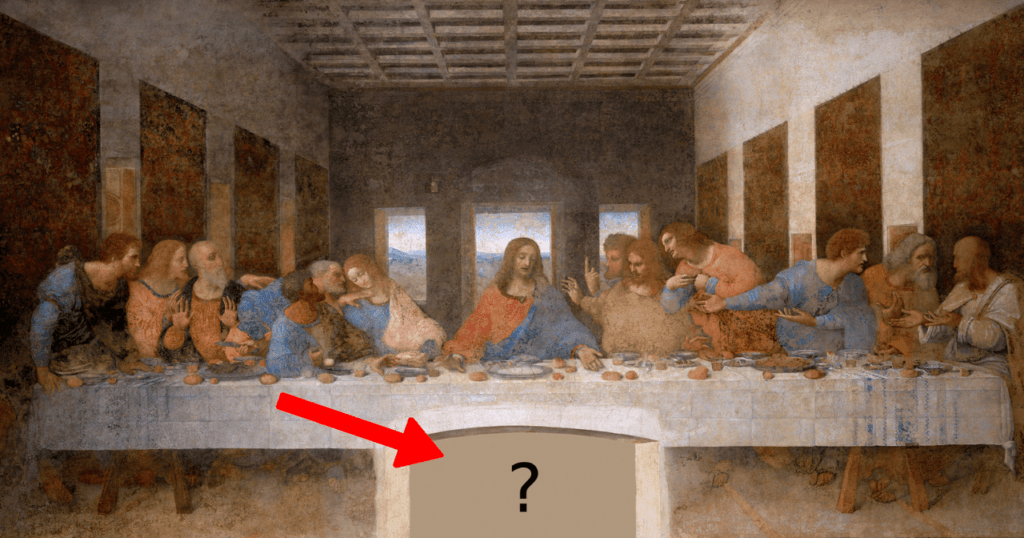
Leonardo da Vinci’s Last Supper on the wall of the refectory of Santa Maria delle Grazie in Milan, Italy – sans Jesus’ feet!
I recently stumbled across an interesting little piece of information that took me down a rabbit hole. It began with a quiz question about a doorway that caused someone to lose their feet.
The feet belonged to Jesus in Leonardo da Vinci’s The Last Supper.
Leonardo painted it on the wall of the refectory of Santa Maria delle Grazie in Milan. Around 1652, the monks decided they needed a doorway through that wall. It was positioned directly beneath Jesus, and making the opening meant cutting away the portion of the painting that included his feet. The doorway was later bricked up, but that part of the painting was gone forever.
I had heard other odd little stories like this (including one about a ladder that has stood in a particular place for a remarkably long time – more to come on that), so I took the doorway info and put it into AI (ChatGPT), and asked, “Are there any other odd little things like this?”
It came back with six more!
One was the ladder story I already knew, which you’ll find more details on below. I’ve also included the references supplied with each of the answers so that you can explore them yourself.
To be perfectly honest, I could turn this list into a travel bucket list! Visiting these places would mean seeing extraordinary architecture, religious sites, art, and history… but I would also arrive with a little story already at hand that might make me stop, look more closely, and more fully experience… the experience!
If you know of any other curiosities like these, send me an email. I’d love to hear the stories and find more locations I should add to my bucket list!
- The Lamb of God ended up with four ears.
In the Ghent Altarpiece, completed in 1432, the lamb representing Christ had its head painted over in the sixteenth century. During conservation in the 1950s, restorers uncovered the original ears but left the later painted face—and its ears—in place. The result was a sacred lamb with two overlapping sets of ears, which remained that way for decades. Later restoration revealed the original, strikingly human-looking face. Source: Belgium’s Royal Institute for Cultural Heritage - Another Last Supper escaped trouble by becoming a different dinner.
In 1573, Paolo Veronese was questioned by the Inquisition over his Last Supper: its bustling cast of extraneous characters was considered inappropriate for the sacred event. Ordered to correct it, he instead changed its stated subject to The Feast in the House of Levi, adding a reference to Luke’s Gospel. A different biblical dinner made the gathering acceptable. The painting survives under that title in Venice. Source: Gallerie dell’Accademia - David had a detachable fig leaf for royal visits.
The V&A’s full-size plaster cast of Michelangelo’s David had a separate plaster fig leaf that could be hung over his genitals using hooks when royalty visited. The museum still has an example of the leaf. The familiar story that Queen Victoria’s shock prompted its creation is anecdotal; the leaf and its use are documented. An actual museum accessory whose purpose was to make a biblical hero presentable to visiting dignitaries. Source: V&A - Notre-Dame’s biblical kings lost their heads during the French Revolution.
In 1793, revolutionaries decapitated the statues in the cathedral’s Gallery of Kings. They represented kings of Judah, but were taken for kings of France, according to the City of Paris’s account. The especially strange sequel: 21 of their heads turned up during building work elsewhere in Paris in 1977. The originals are now in the Musée de Cluny; the cathedral’s replacements belong to its nineteenth-century restoration. Source: City of Paris - A ladder became part of a religious stalemate.
On a ledge above the entrance to Jerusalem’s Church of the Holy Sepulchre sits the famous “immovable ladder.” The Christian communities sharing the church operate under an arrangement preserving their respective rights—the Status Quo—which makes even small alterations sensitive. The ladder has consequently remained associated with that spot for centuries. “Immovable” is slightly misleading: it has occasionally been moved, including during building work, and then returned. Source: Aleteia - Michelangelo’s self-portrait is apparently someone else’s empty skin.
In the Sistine Chapel’s Last Judgement, Saint Bartholomew holds his own flayed skin, an attribute of his martyrdom. The face on that dangling skin is widely identified as Michelangelo’s self-portrait—including by the Vatican Museums. So the artist’s likeness appears in the painting as a discarded human covering. That identification is an accepted interpretation, rather than something Michelangelo explicitly documented. Source: Vatican Museums
- Jesus lost his feet to a doorway.
Leonardo da Vinci’s Last Supper, in the refectory of Santa Maria delle Grazie in Milan, originally included Jesus’s feet beneath the table. Around 1652, a doorway was cut through the wall directly below him, destroying that part of the painting. The opening was later bricked up, but the missing artwork could not be recovered. The conspicuous gap beneath Jesus is the result of a building alteration: somebody needed a door. Source: Conservation history of The Last Supper
To see the video that set me down this rabbit hole, visit https://carmelitemedia.tiny.us/lateraldoorfeet
The Carmelites of the Province of the Most Pure Heart of Mary, in allegiance to Jesus Christ, live in a prophetic and contemplative stance of prayer, common life, and service. Inspired by Elijah and Mary and informed by the Carmelite Rule, we give witness to an eight-hundred-year-old tradition of spiritual transformation in the United States, Canada, Peru, Mexico, and El Salvador, and Honduras.
Please consider supporting their mission
https://carmelitemedia.tiny.us/supportpcm
to make a financial donation.