
This post was originally published on this site.
Matthew 14:13-21
Dear Friends, Today’s meal is not primarily about the Eucharist. It does, however, reflect the beauty and wonder of the eternal gift of Jesus. We are given a symbol of the final, Messianic banquet, the great day of the total victory over evil and death. While the bread and fishes are distinct from the Body and Blood of the Last Supper, they are a good memento of the blessing of the Eucharist for our daily journey.
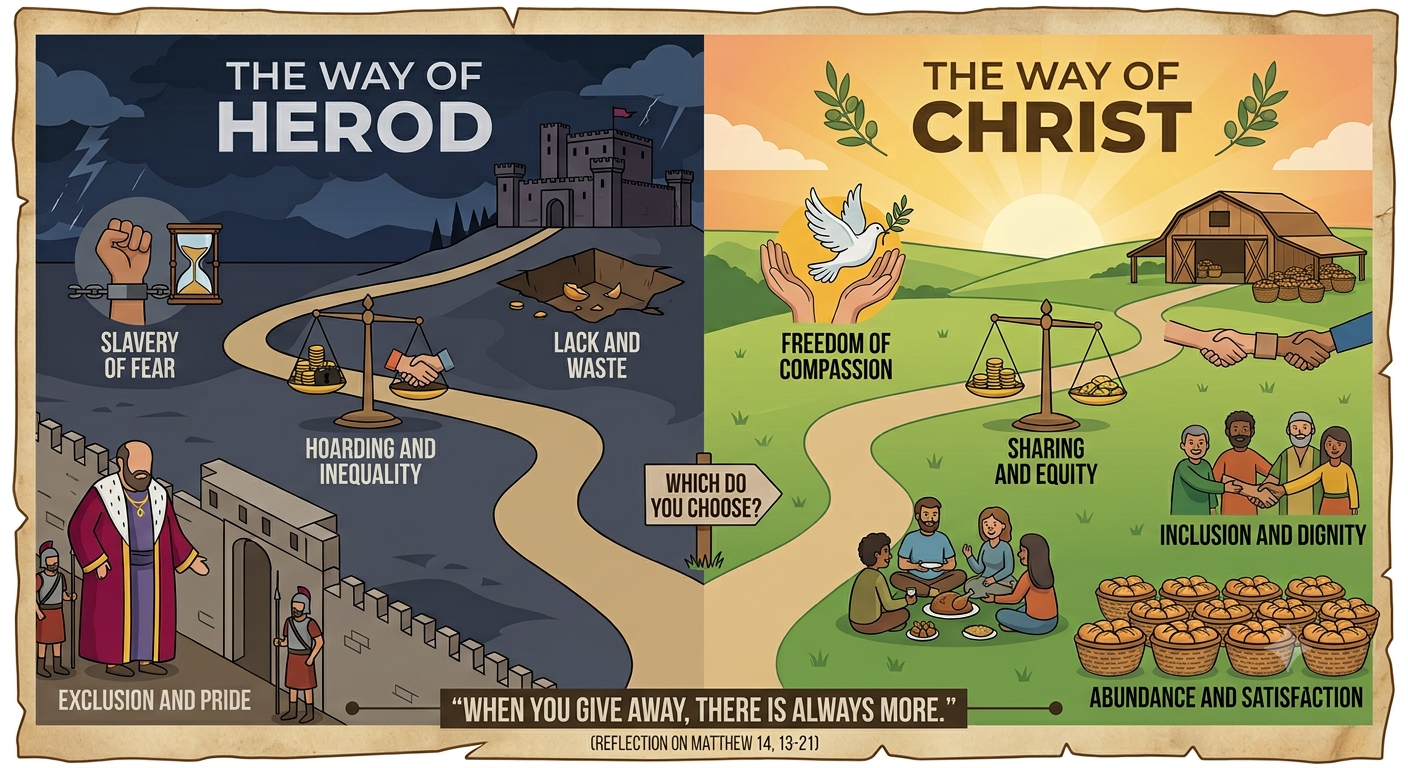
By placing it after Herod’s banquet where John the Baptist was beheaded, Matthew adds to the powerful story of the loaves and fishes. The differences in the two banquets are amazing. Here are just a few of the contrasts revealed in the two meals:
Today’s story is about the loaves and fishes as a sign of God’s power, compassion and love. This story appears six different times in the Gospels. Likewise, it is the only miracle story that is in all four Gospels. Obviously, there is a profound message for us in the very special pattern of repetition.
The story looks backwards and forward in the Divine Plan. It clearly has echoes of the manna in the desert (Exodus 16) and Elisha’s similar fete of feeding the crowd with a few loaves. (2 Kings 4:42-44) More importantly, the language Jesus uses is similar to the institution of the Eucharist at the Last Supper. (Mt 26:26) Finally, it foreshadows the Messianic banquet at the end of time.
Jesus mourning for the death of John the Baptist, sets the context for this great miracle. Jesus models the generosity of moving out himself to the needs of the people in his midst. He responded to the people seeking the Word of God and added the great gift of the Bread of God. This all happens because “his heart was moved with pity.” (Mt 14: 14)
By placing it after Herod’s banquet where John the Baptist was beheaded, Matthew adds to the powerful story of the loaves and fishes. The differences in the two banquets are amazing. Here are just a few of the contrasts revealed in the two meals:
Our world today and throughout history is organized with the values of Herod’s dinner values of exclusion, violence and jealousy. The gospel calls us to enter into Christ’s world by sharing, peace, service and inclusion of all.
Herod’s’ feast degraded women while Jesus’ gathering celebrated the dignity of all. Herod’s guests were the rich, powerful and entitled. Jesus’ guests were the poor and hungry and neglected. Herod displayed extravagance and waste. Jesus satisfied all with twelve baskets leftover.
Jesus teaches us that in the gospel world, the world open and accepting of the loving Father Jesus came to proclaim, things are different. When you give away there is always more. Only when we hold on and hoard and seek to find our security in our possessions do we experience loss and insecurity and fear. In Jesus’ world we begin to see the poor and the hungry not as an inconvenience and burden but as an opportunity to share and serve and love. In this way we multiply our own loaves and fish few as they may be.

