
La sabiduría perdurable del Carmelo: la oración como presencia
“”La oración auténtica comienza en el mundo real, en nuestro yo auténtico, con todas las relaciones que mantenemos con los demás y con nuestras tareas en la vida. La oración no es una vía de escape. Es el contacto con Dios, donde Él viene a nosotros. Eso significa la vida real, en lo más profundo de nuestra propia identidad, en nuestros contactos humanos con los demás».”
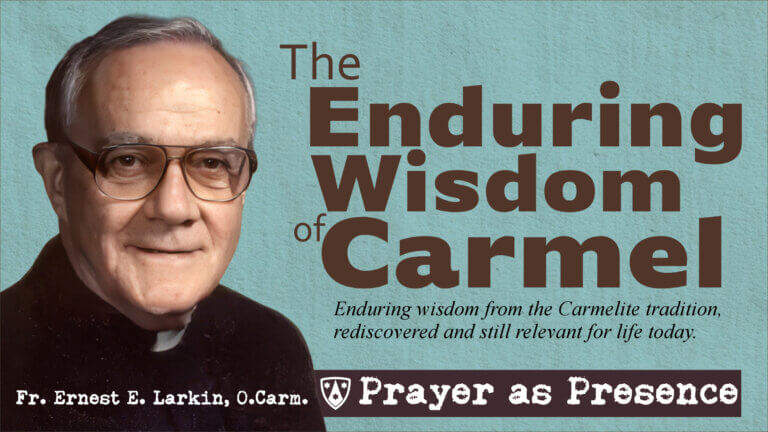
El padre Ernest Larkin es un teólogo y profesor carmelita estadounidense.
La “presencia” puede referirse a la presencia en un lugar o a la presencia ante algo. En el primer caso, se trata de la presencia espacial, es decir, el lugar. Yo estoy en esta habitación; Dios está en la iglesia. Pero, ¿qué significa esto en el caso de Dios? Dios no es un cuerpo, por lo que no puede estar en un lugar desde el punto de vista espacial. Salomón se planteó este problema durante la consagración del templo. Si el universo no puede contenerte, Yahvé —rezó—, ¿cómo puedes «morar» en este templo? La respuesta de Yahvé fue que Él habitaría en el templo, en la medida en que estaría allí escuchando las oraciones de su pueblo y, en una cierta reciprocidad, ellos tendrían presente su voluntad (1 Reyes 8:27; 9:3-9).
Ofrecer a Dios
La presencia de Dios, en otras palabras, es presencia a. Es personal y dinámica. Dinámica, porque Dios está presente allí donde actúa; personal, porque es un agente inteligente, una persona que ama, y está presente allí donde actúa de forma consciente y amorosa.
El escolar que mira el reloj en el aula está presente en la clase, pero no para el profesor. La joven monja Teresa de Jesús, que observaba el reloj de arena durante el momento de la oración mental, estaba en en la capilla, pero sin estar del todo presente ante el Señor. Por otro lado, un chico y una chica pueden crecer siendo vecinos y apenas darse cuenta de la presencia del otro; un día se enamoran y, a partir de entonces, están intensamente presentes el uno para el otro, aunque el joven se marche al servicio militar o la chica se mude a otra ciudad. La presencia personal, ya sea con el hombre o con Dios, es más una experiencia que un hecho físico. El alma, dice santo Tomás, está más presente donde ama que donde anima.
Dios está presente en el mundo en todo momento y en todas partes. No solo es el fundamento del ser y el principio de la vida; es padre, señor, esposo y amigo. Es el Padre que llama a todos los hombres hacia sí (a cada uno por su nombre) en el Hijo, por el poder del Espíritu Santo. Es el Deus operarius de San Ignacio, Dios actuando en el universo, llevando todas las cosas a su plenitud en Cristo.
Cuando correspondemos a esa presencia, estamos rezando. Dios se convierte en una presencia para nosotros, del mismo modo que nosotros somos una presencia para Él. La oración, en otras palabras, es una presencia personal mutua, una presencia mutua a, de ahí su presencia con Alguien. Es un encuentro, una reunión, un contacto. Es una presencia ofrecida y recibida, una llamada y una respuesta, una invitación y una bienvenida, un regalo y una aceptación. La oración es presencia en el amor: «Mi amado para mí y yo para mi amado» (Cant. 7, 16).
Dios es presencia
Este concepto de la oración nos libera de la inmensa carga que supone objetivar y definir a Dios —una tarea imposible, en cualquier caso— y sitúa a Dios en el plano muy real, aunque no conceptual, del “Tú”. El Padre, Cristo o el Espíritu Santo son una presencia amorosa, que lo impregna todo como la atmósfera, como música de fondo o como un entorno divino en el que vivimos, nos movemos y existimos (Hechos 17:28). Pero Dios sigue siendo una persona. No se reduce a una dimensión del universo; es una Presencia evocada por la experiencia, pero más allá de cualquier signo o símbolo; forma parte de la vida, pero está más allá de toda vida; es el principio y el fin y, sin embargo, trasciende por completo las posibilidades más elevadas del hombre. En una palabra, Él es real no porque pueda ser comprendido mediante las categorías de la mente, sino porque “está ahí”. No es un objeto medible ni definible; en el mejor de los casos, las imágenes y los conceptos que utilizamos para identificarlo no son más que una pobre traducción de un amor que desafía cualquier lenguaje adecuado.
A través de la oración surge una nueva realidad, y esa realidad es la persona que reza. La persona que reza es una presencia religiosa; emana las “vibraciones” de quien vive con Dios. Lo Supremo, lo Trascendente, lo Sagrado, el Más Allá en medio de la vida: eso es lo que destaca como preocupación, orientación y interés del hombre religioso. Así son los contemplativos. Así son los místicos, así son todas las personas verdaderamente religiosas que estructuran toda su vida en torno a este valor de Dios en la existencia humana.
Tanto el conocimiento como el amor intervienen en el proceso de desarrollar la presencia religiosa. Pero el amor es la clave. Dios es una presencia para mí cuando lo conozco a través del amor. Es un lugar común en teología afirmar que la gracia proporciona un conocimiento “cuasi-experiencial” de Dios y que la contemplación es una “experiencia de Dios”. La investigación histórica ha demostrado que, para los teólogos medievales, el carácter experiencial del conocimiento que el cristiano tiene de Dios procedía de los afectos. La experiencia mística es una experiencia de amor. La presencia se revela, no al saber mucho sobre la otra persona, sino en un encuentro amoroso de persona a persona.
El problema de hablar de Dios
Entender la oración como presencia supone reformular viejas verdades, quizá en categorías algo nuevas. ¿Cuál es el valor de esta formulación de la oración? En mi opinión, la oración como presencia es una formulación especialmente acertada por dos razones: (1) proporciona un lenguaje; (2) sugiere un programa para cultivar una vida de oración en un contexto contemporáneo.
En primer lugar, resuelve el problema del lenguaje. Hablar de Dios de forma significativa siempre ha sido un problema, porque Dios vive en una esfera diferente a la del hombre; habita en una luz inaccesible (1 Tim. 6, 16). Para que podamos hablar de Él, sea como sea, se requiere un ajuste constante, ya que Él se parece más a lo que no somos que a lo que somos. Pero hoy en día el problema se ve agravado por el cambio cultural, los cambios en los patrones de pensamiento y de vida que nos han hecho sentir incómodos con las antiguas formulaciones sobre Dios y la religión. Aún nos queda por desarrollar nuevas formas aceptables. Los signos de esta transición cultural en la religión son la sensación de la ausencia de Dios en lugar de su presencia en nuestro mundo, las teologías de la “muerte de Dios” y la noche oscura cósmica que parece afectar a todos los niveles de la experiencia religiosa, incluso mientras el hombre sigue conquistando aspectos técnicos del universo mediante vuelos a la Luna. Vivimos en una época abandonada por Dios porque nuestras formas y estructuras heredadas no se corresponden con la forma en que pensamos y sentimos acerca de Dios y del mundo de la fe. El ímpetu y el dinamismo de nuestra fe y nuestra caridad se encuentran en una longitud de onda diferente a la de las imágenes y los conceptos del pasado.
Dios está en nuestro mundo, sin duda; es inmanente. Pero no es nuestro mundo ni ninguna parte de él; es totalmente trascendente. ¿Cómo podemos expresar a este Ser inefable? En cierto sentido, está “ahí fuera”, pero no se limita a estar junto a otras causas y a la realidad creada; es el interior de todas las cosas, el centro dinámico de la vida, que se manifiesta en las personas, los acontecimientos y la historia.
La doble realidad de Dios
El concepto de «presencia» parece captar esta doble realidad de Dios. Protege la realidad divina, al tiempo que sitúa a Dios en la condición humana. Los signos y los símbolos se funden con Su Presencia. Dios sigue siendo Dios, pero se le reconoce en el hombre: en uno mismo, en el prójimo, en el mundo que nos rodea. Las distinciones tajantes de las categorías más intelectualistas y estáticas dan paso a la comprensión de persona a persona y a los temas personalistas.
Abraham Maslow relaciona la capacidad de unir los opuestos y de mantener unidas ambas extremidades del espectro con el logro de una personalidad desarrollada. Escribe:
Es como si las personas menos desarrolladas vivieran en un mundo aristotélico en el que las clases y los contrastes tienen límites bien definidos y son mutuamente excluyentes e incompatibles. Por ejemplo: hombre-mujer, egoísta-altruista, adulto-niño, bondadoso-cruel, bueno-malo. Pero lo que las personas que se realizan a sí mismas ven como un hecho es que ‘A’ y ‘no A’ se interpenetran y son uno, que cualquier persona es a la vez buena y mala, hombre y mujer, adulto y niño. No se puede situar a la persona en su totalidad en un continuo solo como un aspecto abstracto de una persona.
Los místicos han vivido la coincidencia oponentes. El hecho es que Dios y el hombre “se interpenetran”. El discurso sobre Dios y el discurso sobre el hombre se incluyen mutuamente, y uno de ellos es imposible sin el otro. Dios está inconmensurablemente por encima y más allá de nosotros, pero, en cierto sentido, somos más Dios que nosotros mismos. El concepto de presencia nos permite convivir con este misterio. La presencia eleva el discurso al nivel de la persona y al impulso conjunto del amor y el conocimiento, mientras que otras definiciones de la oración tienden a objetivar en exceso de manera racionalista. La presencia, en otras palabras, es menos intelectual y más total, más personal, más afectiva. No es necesario tener ideas claras sobre Dios para conocerlo profundamente. El amor es una puerta de entrada mucho mejor a la vida íntima de Dios que un gran conocimiento, tal y como han subrayado los santos y los místicos a lo largo de los siglos.
Un programa de oración para nuestros tiempos
Pero la aportación más importante del concepto de la oración como presencia es que sugiere un programa de oración para nuestra época. En concreto, sugiere cómo comienza una vida de oración, cómo se desarrolla y hacia dónde se encamina.
En primer lugar, este concepto nos recuerda que la oración auténtica comienza en el mundo real, en nuestro yo real, con todas las relaciones que mantenemos con los demás y con nuestras tareas en la vida. La oración no es una vía de escape. Es el contacto con Dios. donde Viene a vernos. Eso significa la vida real, en lo más profundo de nuestra propia identidad, en nuestros contactos humanos con los demás. Dios no es una abstracción que evocamos mediante malabarismos mentales. Tampoco se manifiesta entre nosotros en teofanías, como lo hacía en el Antiguo Testamento. Ha venido en Cristo el Hombre y, como dijo san Juan de la Cruz, nos ha dicho todo lo que tenía que decirnos en Cristo. Pero Cristo no está separado de sus miembros; sigue viviendo en el mundo humano, en sus miembros. Esto quiere decir que la presencia de Dios es diáfana hoy en día, resplandeciendo en el rostro de Jesús, al tiempo que Jesús se refleja en los rostros de sus miembros, especialmente en el anawim de nuestro tiempo. Qué cristianas son las palabras de Dostoievski: «Quien quiera encontrar el rostro del Dios vivo no debe buscarlo en el firmamento vacío de su mente, sino en el amor humano».
De hecho, podríamos presentar un sólido argumento bíblico y teológico a favor de la autorrevelación de Dios como presencia. Cuando Moisés preguntó por el nombre de Yahvé, recibió la respuesta: “Yo seré”. Este es el nombre de Dios. Él es una Presencia. Es una Presencia en el Templo y, más tarde, en la sinagoga, porque allí se ofrece a sí mismo y allí es recibido: Él habita en ese lugar. En el Nuevo Testamento, cuando se adora a Dios en espíritu y en verdad, las personas y las comunidades se convierten en su templo. Él las posee como la Presencia que da luz y vida a sus vidas. La morada en el interior es la faceta personal de la gracia: tener gracia (tener el favor), según San Buenaventura, es la que nos concede Dios (haberi a Deo).
Cómo se desarrolla la oración
¿Cómo marca la presencia las pautas para desarrollar la oración en la vida de cada uno? La respuesta radica en la naturaleza de la presencia personal. La presencia es una realidad que se va desarrollando, no un logro definitivo. Al igual que la amistad o el amor, crece —o se desvanece— a medida que crecen la apertura y el amor. Esto quiere decir, de forma sencilla y categórica, que la presencia crece con la madurez.
¿Qué es la madurez sino la capacidad sana de trascender uno mismo en el conocimiento y el amor, de salir del propio y mezquino encerramiento y encontrarse con la realidad objetiva, especialmente con las personas y, en última instancia, con Dios? De esto se tratan la autorrealización, la plenitud personal y la madurez. Esta es la verdadera “plena realización de uno mismo”, el tipo de plena realización de la que hablaba Pablo VI en El desarrollo de los pueblos. Allí, el Papa dijo que tenemos tanta obligación de desarrollarnos personalmente como de salvar nuestras almas. Habló de la realización personal según el Evangelio, que, paradójicamente, se logra mediante el dar y la renuncia.
Con esta reflexión nos situamos en el corazón de la vocación contemplativa. Los contemplativos existen para rezar, para convertirse en Cristo en la oración. Pero, paradójicamente, esto equivale a decir que existen para convertirse en ellos mismos. Thomas Merton lo expresó de forma magnífica en una de sus últimas entrevistas. Identificó el crecimiento en la oración con el crecimiento personal. “Lo único que podemos hacer —dijo— es intentar ser nosotros mismos con honestidad”. El yo al que se refiere, por supuesto, no es nuestro yo ilusorio, sino nuestro yo real, que se posee a sí mismo al entregarse. “Lo que realmente importa no es cómo sacar el máximo partido a la vida, sino cómo recogerse en uno mismo para poder entregarse plenamente”.“
El recogimiento es presencia total
Este consejo se caracteriza por su tono realista. La oración exige renuncia, pero también implicación y compromiso con los demás. El contemplativo se acerca a los demás en profundidad más que en número, buscando la presencia crística en el mundo en su fuente, Cristo mismo como persona, más que en sus múltiples manifestaciones como persona, más que en sus múltiples manifestaciones en los hijos de los hombres. Pero esa orientación o énfasis nunca puede convertirse en una actividad exclusiva, de modo que uno excluya a otros seres humanos de su amor y su preocupación. El tiempo dedicado a los demás fuera de la comunidad contemplativa será mínimo, pero el corazón del contemplativo es tan grande como el mundo.
El consejo de Merton es muy oportuno. “Recobra la compostura para poder entregarte por completo”. La recogimiento no significa alejarse de la realidad. Significa estar todo ahí, estar totalmente presente allí donde estás y en lo que estás haciendo, estar presente en profundidad, es decir, en todos los significados de la situación. Así, la persona sensible que se muestra atenta y comprensiva ante los tímidos esfuerzos de alguien tímido por acercarse a los demás está “recolectada”. Lo mismo ocurre con el oyente que se esfuerza al máximo por prestar atención y escuchar, por sintonizar con la verdad y la realidad y desconectarse de la distorsión y la ilusión. El recogimiento significa romper con el mundo cerrado del yo aislado, declarar la independencia del orgullo herido y la mezquina autocomplacencia en favor de vivir para algo más grande y mejor que uno mismo. El silencio y la soledad, en otras palabras, no son refugios de la vida. Son una forma superior de comunicación con Dios y con los semejantes; de lo contrario, son prácticas inválidas para el contemplativo.
El objetivo de la oración
La aportación fundamental del concepto de «presencia» es precisamente este recordatorio del objetivo global de una vida de oración; quizá en el pasado se hayan establecido demasiadas distinciones tajantes. Considerar la vida de oración como una unión con Dios en un sentido individualista, como una piedad del tipo «Jesús y yo», solo podía provenir de dicotomizar la vida y convertir un aspecto de la misma en la totalidad. En cualquier caso, los cristianos de hoy, tanto dentro como fuera de los conventos, ven la vida de oración como la integración del amor a Dios, del amor a los demás y del auténtico amor propio. Alguien descubrió un profundo secreto de la respuesta cristiana al identificar la palabra «J.O.Y.» (alegría) como un acróstico de «Jesús, los demás, tú», los tres elementos de toda vida cristiana. La conocida máxima de Gabriel Marcel también encaja aquí: nos cuenta que buscó a Dios en sí mismo y no lo encontró; luego lo buscó en su propia alma y tampoco lo encontró; finalmente, lo buscó en los demás y encontró tanto a Dios como a los demás y a sí mismo.
“La ”presencia“ explica estos factores. Dios se convierte en todo el mundo de uno a medida que aumenta la santidad de uno, pero sin anular a los demás ni a uno mismo. Hay dos facetas básicas de este amor, ilustradas por el ”yo-tú“ de Platón y su ”nosotros“. En la relación ”yo-tú“, dos personas se miran la una a la otra con amor; en la relación ”nosotros“, esas mismas dos personas se enfrentan a una tarea común. Cada relación denota un tipo diferente de presencia, una faceta diferente del amor. La primera forma es la presencia en su forma más intensa. Es la unión esponsal, contemplativa y mística con Dios. La otra forma es la forma ”débil“ de presencia, en términos de una conciencia manifiesta de Dios como persona. Pero lo que cuenta es el amor verdadero y, idealmente, el amor verdadero es el mismo en ambos casos. La colaboración con Dios en un proyecto común, trabajar con Dios para construir comunidad, puede parecer menos ”religiosa», pero forma parte de toda vida cristiana, incluso de la vida contemplativa, y es una forma de presencia que aporta su propia contribución a la vida de oración. Las formas fuerte y débil de presencia son complementarias y se incluyen mutuamente. Ambas son formas de oración: una es oración explícita y la otra, oración implícita.
Este enfoque hace hincapié en la continuidad entre la vida y la oración y desmonta las falsas dicotomías entre el amor a Dios y el amor al prójimo. La oración no puede limitarse a los momentos libres de la vida; está entrelazada con todo lo que hacemos. Toda la vida es una búsqueda de Dios. Esa búsqueda se manifiesta en las alegrías y los sacrificios humanos, en la búsqueda de los valores humanos, así como en la confrontación directa. Algunos valores humanos son más fundamentales que otros, pero todos ellos se elevan hacia Dios, que es lo Supremo, ante quien todo lo demás palidece hasta convertirse en la nada. El vínculo de la caridad une nuestros esfuerzos humanos —el empeño por crecer, por ser personas amorosas— y la unión con Dios. El verdadero crecimiento y desarrollo siempre se medirán por la sensación de la presencia de Dios en la vida de cada uno, no como un tipo concreto de experiencia —ya sea dulce o árida—, sino como una fuerza efectiva que nos convierte en personas fieles, esperanzadas y amorosas, para quienes Dios está por encima de todo y en todos nosotros.
Para obtener más información sobre la historia, la teología y la espiritualidad de los carmelitas, visita la Colección Carmelitana en carmelitanacollection.org
Acerca del padre Larkin:
El padre Larkin, Ernest E. Larkin, nació en Chicago el 19 de agosto de 1922. Ingresó en el Mount Carmel College, en las Cataratas del Niágara (Ontario), como seminarista de secundaria, y se graduó en junio de 1939. Hizo su profesión de votos en 1940 y se licenció en Filosofía por el Mount Carmel College en 1943. Fue ordenado sacerdote el 8 de junio de 1946. El padre Larkin completó sus estudios de teología en Whitefriars en junio de 1947 y cursó estudios de posgrado en literatura inglesa en la Universidad Católica durante los veranos. Completó sus estudios de posgrado en teología en el “Angelicum” (Universidad de Santo Tomás), en Roma, y se le concedió el doctorado en Teología (STD) en 1954. Larkin fue destinado a Whitefriars, el seminario mayor de la Orden, donde ejerció como profesor, director espiritual y, finalmente, maestro de estudiantes entre 1951 y 1959. En 1959, Larkin fue nombrado profesor de teología ascética y mística en la Universidad Católica de América, donde continuó como profesor adjunto y, posteriormente, como profesor asociado hasta su dimisión en 1971. Durante este periodo también impartió clases en el programa de máster para maestras de novicias en el St. Mary’s College de Notre Dame y presentó su primera ponencia ante la Sociedad Teológica Católica de América. “El papel de las criaturas en la vida espiritual” (1962). También fue editor asesor en el ámbito ascético-místico de la “Nueva Enciclopedia Católica”, en la que se publicaron varios de sus artículos. Durante su estancia en la Universidad Católica, Larkin pronunció discursos en la Conferencia de Superiores Mayores de la Orden de los Hombres de Mundelein (Illinois) y intervino en varias reuniones de la Sociedad de Derecho Canónico de Estados Unidos, así como en la Conferencia sobre la Formación de las Hermanas. Participó activamente en su propia comunidad carmelita, formando parte del consejo provincial de 1966 a 1972, con responsabilidades especiales en el ámbito de la vida espiritual. Fue elegido delegado al Capítulo General de Roma en 1965, 1968, 1971 y 1983. Unos problemas de salud le obligaron a tomarse una baja médica de la universidad en febrero de 1970. Larkin fue invitado a ocupar el cargo de teólogo residente en la recién creada diócesis de Phoenix (Arizona) y, tras su baja durante el curso académico 1970-1971, dimitió de la Universidad Católica. En 1972, el padre Larkin cofundó el Instituto Kino, que se constituyó como la Escuela Diocesana de Phoenix de Educación Religiosa para Adultos, destinada al clero, a los religiosos y a los laicos. Fue su primer presidente y contribuyó a definir los objetivos y la misión del Instituto. El número de matriculados aumentó hasta alcanzar los 1 780 alumnos en dos años.
Durante la década de los 1970, Larkin impartió numerosos retiros y talleres por todo el país y en el extranjero, incluido el Lejano Oriente. Impartió clases en los cursos de verano de la Universidad de San Luis (1978) y de la Universidad de Creighton, en Omaha (1979), y fue el enlace del obispo con el Movimiento Carismático Católico en Phoenix.
Durante este periodo se publicaron varios artículos de Larkin, y en 1973 se publicó el innovador libro “Spiritual Renewal of the American Priesthood” (Renovación espiritual del sacerdocio estadounidense), encargado por la Conferencia Episcopal. Larkin fue coeditor y redactó el borrador final. En la década de 1980, el ministerio de Larkin incluyó programas de renovación en Notre Dame para ’Retreats International“ y el ”Programa de Formación Continua para el Clero“, así como programas de formación permanente para los carmelitas en Roma. Fue asesor de la sección de espiritualidad de la revista internacional ”Concilium“ y del ”Centro para el Desarrollo Humano“, en Washington, D.C. En esos años también se publicaron dos libros del padre Larkin: ”Silent Presence“ (1981, revisado y ampliado en 2001), una reflexión sobre el discernimiento como proceso y como problema, y ”Christ Within Us“ (1984), un libro de ensayos que explora la experiencia contemporánea de Cristo, la Iglesia y el yo.
En 1982, Larkin fue miembro fundador del “Carmelite Forum”, un grupo de estudiosos de ambas observancias dedicados al estudio y la promoción de la espiritualidad carmelita. Sus seminarios anuales, celebrados en el St. Mary’s College de Notre Dame, han atraído a clérigos y laicos de todas partes del país. Las ponencias de Larkin se han publicado en revistas y recopilaciones del seminario, así como en casetes de audio. (Publicaciones ICS) “The Carmelite Forum” en St. Mary’s, en Notre Dame, junio de 2000. Fue publicado por Paulist Press junto con otros ensayos de ese seminario en “Carmelite Prayer”, un libro homenaje en honor al P. Ernie, pionero en el estudio de la espiritualidad carmelita.
Su artículo “Espiritualidad del Jubileo” fue galardonado con el primer premio de la Asociación de Prensa Católica en la categoría de “Artículos sobre espiritualidad del año 2000”.”
El padre Larkin siguió impartiendo clases, dirigiendo retiros, participando en talleres y escribiendo hasta su fallecimiento en 2006.
Los Carmelitas de la Provincia del Purísimo Corazón de María, en fidelidad a Jesucristo, viven en una postura profética y contemplativa de oración, vida común y servicio. Inspirados por Elías y María e informados por la Regla Carmelita, damos testimonio de una tradición de ocho siglos de transformación espiritual en los Estados Unidos, Canadá, Perú, México, El Salvador y Honduras.
Considere la posibilidad de apoyar su misión
https://carmelitemedia.tiny.us/supportpcm
para hacer una donación económica.