
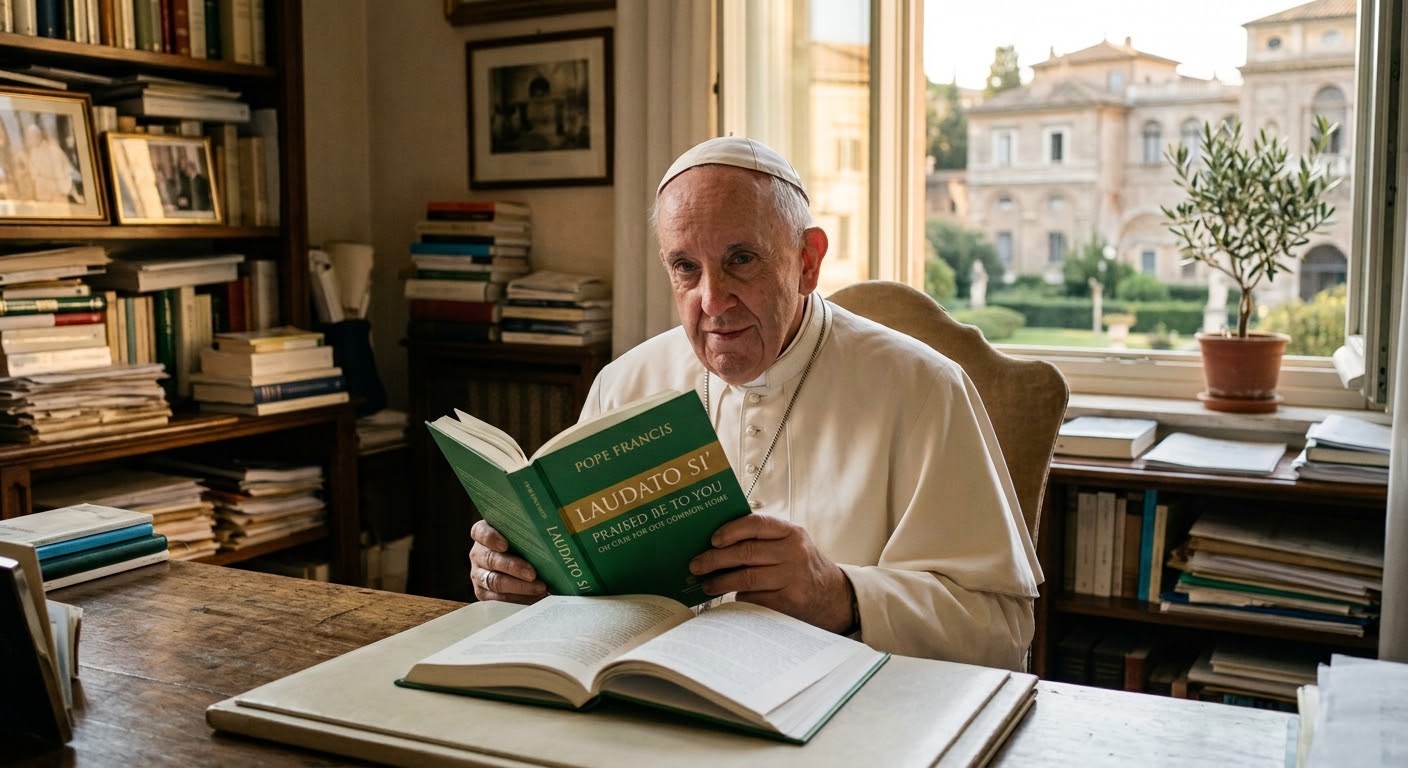
Laudato Si´: Pope Francis’ Call to Conversion
导言
I am going to offer a series of blogs on Laudato Si´, the transforming encyclical of Pope Francis on our environmental crisis. This document was written more than a decade ago. It continues to grow in importance and relevance by the hour. In this Papal letter, Francis sets forth a call to respond with urgency, intelligence, sacrifice and generosity to the massive ecological crisis confronting our world.
My message will consider just one small part of the encyclical’s call to personal conversion in the face of our world threatening ecological crisis. In the end, Francis states that ecological conversion has a precious contribution to make toward the renewal of humanity.
In the first paragraph about ecological education and spirituality in chapter six, Pope Francis makes this important observation: “Many things have to change but we human beings above all, have to change. We lack an awareness of our common origin, of our mutual belonging, and of a future to be shared with everyone. This basic awareness would enable the development of new convictions, attitudes, and forms of life. A great cultural, spiritual, and educational challenge stands before us, and it will demand that we set out on the long path of renewal.” (Laudato Si´ #202)
Pope Francis begins his text with the first words of St. Francis of Assisi’s Canticle to creation:
“Praise be to you, my Lord.” In the words of this beautiful canticle, the Francis reminds us that our common home is like a sister with whom we share our life and a beautiful mother who opens her arms to embrace us.” (Laudato Si´ #1)
“This sister now cries out to us because of the harm we have inflicted on her by our irresponsible use and abuse of the goods with which God has endowed her. We have come to see ourselves as her Lords and masters, entitled to plunder her at will. The violence present in our hearts, wounded by sin, is also reflected in the symptoms of sickness evident in the soil, in the water, in the air, and in all forms of life.” (Laudato Si´ #2)
Pope Francis’ message is wide-ranging and comprehensive. He applies the most advanced scientific and rational responses to the ecological crisis. He concludes, “Finally, convinced as I am that change is impossible without motivation and a process of education, I will offer some inspired guidelines for human development to be found in the treasure of Christian spiritual experience.” (Laudato Si´: #15)
The following blogs will offer some reflections on the need for conversion. While chapter six, Ecological Education and Spirituality, is less than ten percent of the entire document, it is critical to the basic call for change. This conversion is related intimately to the ecological crisis we often call climate change. There is much more to it than climate change. In the end, the only real change that will make us responsible for a healthy and cooperative climate and environment will be a change in our lifestyle. This is only possible through a life that truly embraces the values of the gospel of Jesus Christ.
Addendum
In these several blogs on Laudato Si´ about Ecological Conversion, I will be adding a few items of helpful Information, mostly from the Carmelite Newsletter of the Province of the Most Pure Heart of Mary with special thanks to Dennis Kalob, editor. Likewise, I will use numerous quotes from the encyclical letter both within the text of the blogs and in reflective quotes at the end of each blog. The hope is to familiarize the reader with the significance of Francis’ radical vision for our time. While these many quotes from the Papal letter will, no doubt, make the material more difficult to read, I believe it is well worth the effort.
World Day of Prayer for the Care of Creation,
September 1
“They shall beat their swords into ploughshares and their spears into pruning hooks.” (Isaiah 2:4) That is the theme chosen by Pope Leo XIV for this year’s World Day of Prayer for the Care of Creation
The Holy Father’s message for the World Day of Prayer for the Care of Creation highlights the connection between armed conflict and environmental degradation. Such degradation constitutes both a serious violation of our duty to care for creation, as well as a long-term threat to the lives of hundreds of millions of people. The now widespread awareness of the impact of war on natural resources has not led to the creation of adequate institutions or to responsible decisions aimed at resources preventing conflict and resolving disputes peacefully. The title – a message in which Isaiah prophecies the transformation of weapons into agricultural tools – is an explicit invitation to prioritize development and sustainability over violence and destruction. (Carmelite Newsletter on Laudato Si´)
2025 年全球死于战争的人数:24 万+(不包括因基础设施被毁、饥饿等造成的间接死亡人数)
因战争而流离失所的人数不断增加,目前已超过 1.2 亿。.
2024 年,全球军费开支将达到 $2.7 万亿美元;美国将花费 37% 美元。.
军费开支继续增加。战争是一项非常有利可图的生意。.
The U.S. Defense Department is among the world’s top greenhouse gas emitters.
Laudato Si’ calls all of us to hear the cries of the earth and the cries of the poor. War represents the loudest possible cries! It is severely destructive of the natural world and the poor are almost always the most victimized by it. Just the preparation for war takes money away from efforts that can house, feed, educate and care for the most vulnerable. Much is said about “just wars.” The truth is, however, few (some say none) are ever truly justified, though those with great power and privilege try to convince us otherwise…constantly.
In a Pentagon prayer service (March 25, 2026), U.S. Defense Secretary, Pete Hegseth, prayed for “overwhelming violence of action against those who deserve no mercy.” Hegseth has repeatedly exalted violence and has done so in the name of Christianity.
以下是教皇利奥十四世宗座 2026 年 4 月 11 日在全球和平祈祷守夜活动中的讲道节选。.
Enough of the idolatry of self and money! Enough of the display of power! Enough of war! True strength is shown in serving life. With evangelical simplicity, Saint John XXIII once wrote: “The benefits of peace will be felt everywhere, by individuals, by families, by nations, by the whole human race.” And echoing the incisive words of Pius XII, he added: “Nothing is lost by peace; everything may be lost by war” (Encyclical Letter Pacem in Terris, 116).
因此,让我们团结千百万男女老少的道德和精神力量,今天,他们选择相信和平,关爱伤口,修复疯狂战争留下的破坏。我收到了无数来自冲突地区儿童的来信。在阅读这些信件的过程中,我们透过纯真的视角,看到了一些成年人引以为豪的恐怖和不人道的行为。让我们倾听儿童的声音!
Dear brothers and sisters, there are certainly binding responsibilities that fall to the leaders of nations. To them we cry out: Stop! It is time for peace! Sit at the table of dialogue and mediation, not at the table where rearmament is planned and deadly actions are decided! Yet there is a no less significant responsibility that falls to all of us—men and women from all over the world. We are an immense multitude that rejects war not only in word, but also in deed. Prayer calls us to leave behind whatever violence remains in our hearts and minds. Let us turn to a Kingdom of peace that is built up day by day—in our homes, schools, neighborhoods, and civil and religious communities. A Kingdom that counters polemics and resignation through friendship and a culture of encounter. Let us believe once again in love, moderation and good politics. We must form ourselves and get personally involved, each following our own calling. Everyone has a place in the mosaic of peace!

